
A custom wood shadowbox fence—known across Charlotte as the “Good Neighbor Fence”—delivers symmetrical curb appeal and balanced wind relief for local backyards. When property boundaries border adjacent residential lots in communities like Ballantyne, SouthPark, Huntersville, or Matthews, deciding which homeowner receives the finished face of a fence can occasionally lead to neighborhood tension. The shadowbox design permanently resolves this issue by alternating vertical pickets across opposing sides of the structural horizontal rails, producing an identical, beautifully finished presentation on both sides of the fence line.
At Amour Fence, we specialize in stick-built, custom-crafted wood fencing constructed board by board right in your yard. We never install prefabricated, stapled panels that warp or buckle under the shifting humidity of the Carolina Piedmont. Engineered specifically to withstand the unique meteorological challenges of North Carolina—including sudden convective thunderstorm gusts, oppressive summer humidity, and dense, expanding Cecil subsoils—our shadowbox fences blend architectural symmetry with heavy-duty structural resilience.
Technical Specifications: Shadowbox Architecture & Framing
| Architectural Parameter | Standard Specification | Heavy-Duty / Estate Upgrade |
|---|---|---|
| Standard Heights | 6 Feet (72 Inches) | 8 Feet (Subject to Charlotte UDO Variance / ARC Approval) |
| Visual Screening Level | Semi-Private (~85% Direct Sightline Blockage) | High Semi-Private (~90% with 2" Overlap Spacing) |
| Wind Permeability | 30% to 40% Continuous Airflow Relief | 35% Engineered Breeze Channeling |
| Lumber Options | Hand-Selected Western Red Cedar or Pressure-Treated Pine | Clear Architectural Grade Western Red Cedar |
| Picket Dimensions | Full 5/8" x 5-1/2" (True 1x6) Nominal Boards | 3/4" x 5-1/2" Premium Heavy Rough-Sawn Timber |
| Picket Spacing | 2-1/2" to 3-1/2" Alternating Front-to-Back Spacing | 2" Tight Overlap Alternating Configuration |
| Structural Runners | 3 Horizontal 2x4 Pressure-Treated Runners | 4 Horizontal 2x4 Runners (Mandatory for 8-Foot Spans) |
| Post Dimensions | 4x4 Ground-Contact Pressure-Treated Pine Posts | 6x6 Heavy Timber Posts (Corners, End-Runs & Gates) |
| Footing Depth | 30 to 36 Inches Embedded in Cecil Red Clay | 36 to 42 Inches with Compacted Crushed Stone Base |
| Fasteners | Ring-Shank Hot-Dipped Galvanized Exterior Nails | 304/316 Stainless Steel Framing & Picket Fasteners |
| Warranty | 3-Year Limited Workmanship Warranty | 3-Year Limited Workmanship Warranty |
Architectural Profiles: The “Good Neighbor” Alternating Picket Design
The distinguishing architectural hallmark of the shadowbox fence is its staggered, alternating board pattern. Rather than nailing all pickets side-by-side along a single plane—as seen on a traditional Solid Wood Privacy Fence—shadowbox pickets are mounted alternately to the front and rear faces of the horizontal 2x4 stringers.
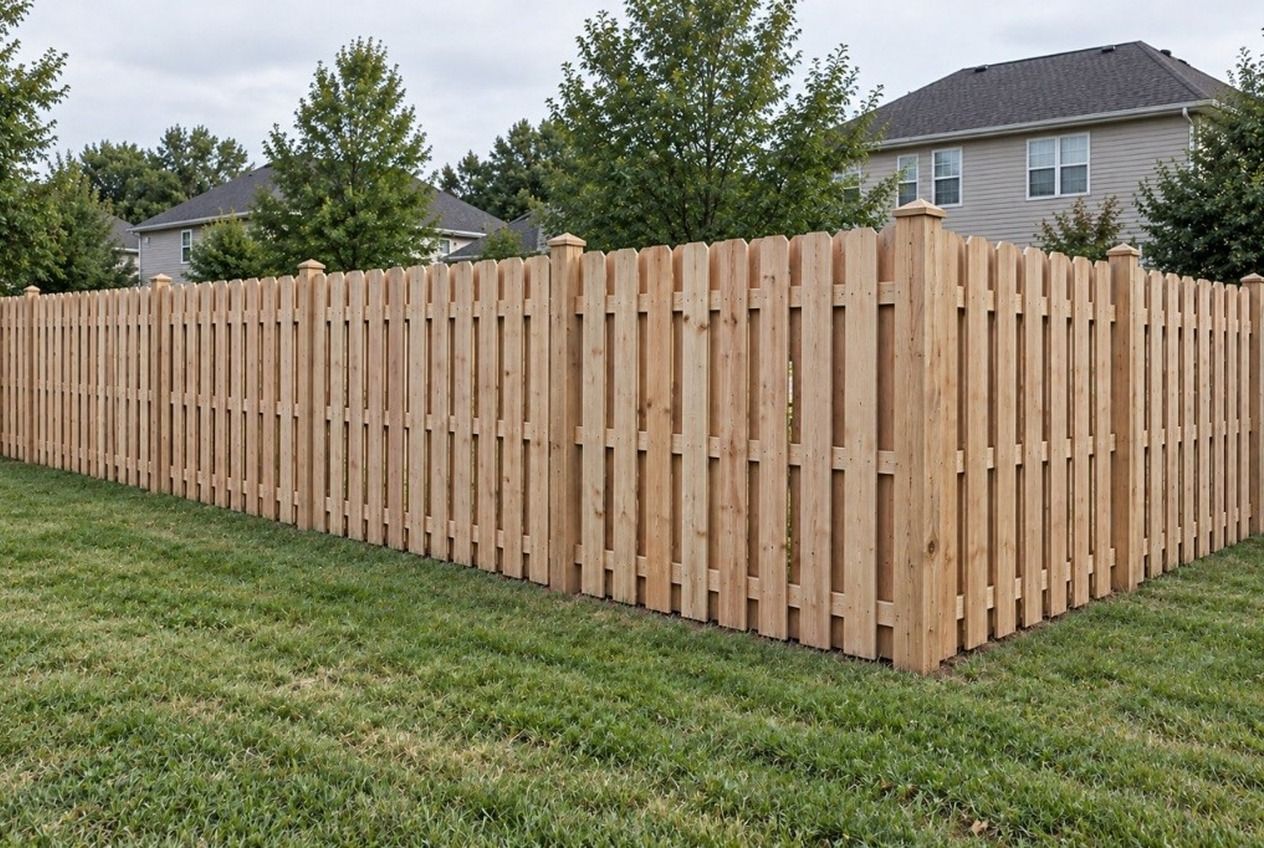
How Alternating Pickets Function
When viewed directly perpendicular from the street or neighboring yard, the fence presents a nearly solid barrier. The visual overlap between the exterior and interior boards blocks direct line-of-sight into patios, swimming pools, and entertaining zones. However, when viewed from an acute angle, the spatial pocket between the boards opens slightly, introducing depth, soft shadow lines, and natural dimension that traditional flat privacy panels cannot replicate.
- Symmetrical Curb Appeal: Both you and your adjoining neighbors look at an identical, high-grade timber surface. Neither property owner is forced to look at bare structural posts or exposed 2x4 framing rails.
- Cost-Sharing Synergy: Because shadowbox fences satisfy community “good neighbor” covenants, adjoining homeowners in subdivisions across Mecklenburg and Union counties frequently agree to split fence installation and maintenance costs 50/50.
- Top Trim Customization: Shadowbox fences can be installed with classic dog-ear picket tops, scalloped arches, or upgraded with a continuous 2x6 horizontal top cap with decorative 1x4 fascia moulding for a refined, furniture-grade transition.
Carolina Piedmont Engineering: Aerodynamic Wind Relief & Red Clay Stability
The climate and soil mechanics of the Charlotte metropolitan region impose severe physical stresses on outdoor wooden structures. Summer across the Piedmont regularly brings intense heat indexes, prolonged high humidity, and violent afternoon severe thunderstorms capable of producing straight-line winds exceeding 50 to 65 mph.
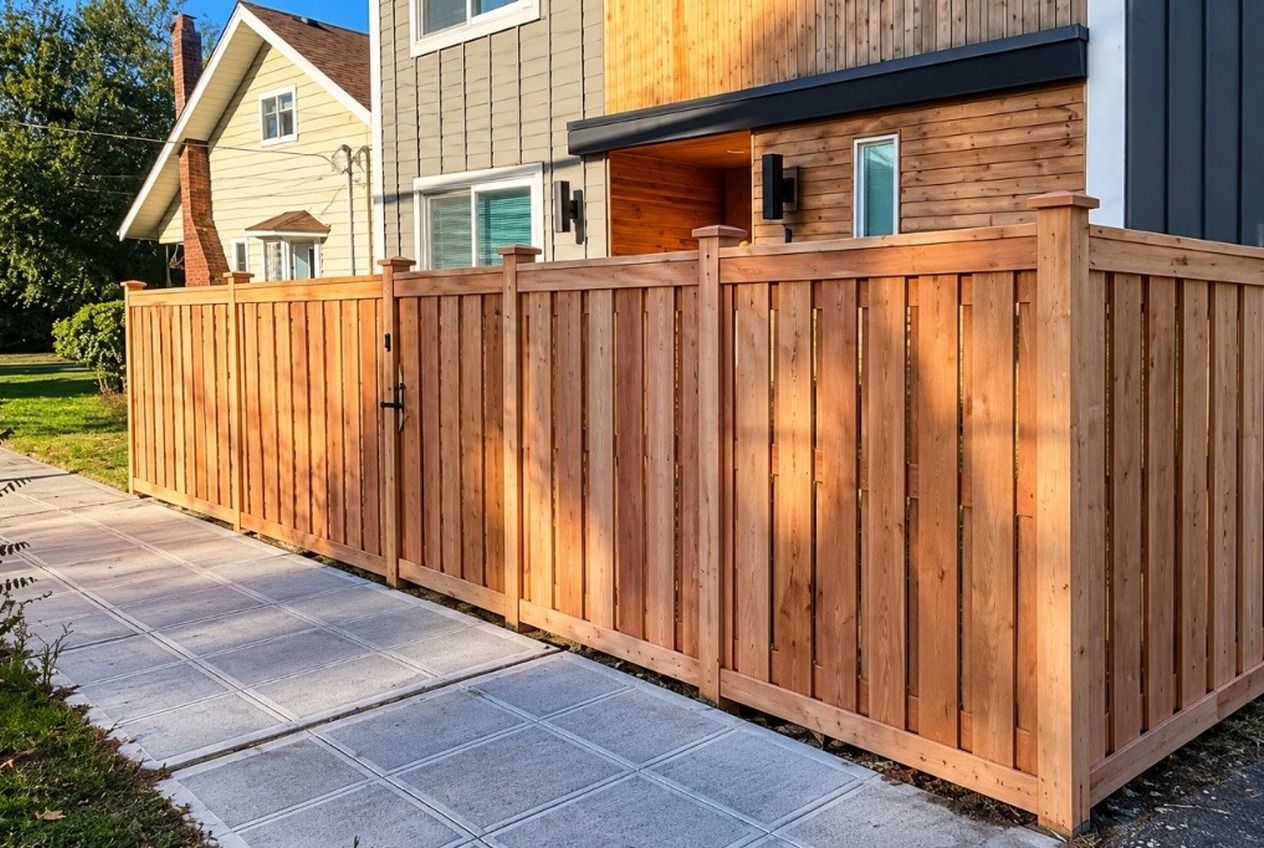
Why Shadowbox Fences Outperform Solid Privacy in High Winds
A traditional solid privacy fence acts as an impermeable physical sail. When severe gale-force gusts strike a solid 6-foot wooden wall, hundreds of pounds of lateral wind load transfer directly into the posts, fasteners, and concrete foundations, frequently snapping posts at the groundline or heaving concrete collars out of saturated soil.
The shadowbox fence eliminates this catastrophic sail effect through natural aerodynamic permeability:
- 30% to 40% Wind Shear Dissipation: The staggered openings between alternating boards allow ambient breezes and storm microbursts to filter directly through the fence structure. This significantly reduces dynamic drag and air pressure accumulation against the fence face.
- Backyard Airflow & Thermal Cooling: Solid fences can turn a Charlotte backyard into a stagnant, stifling heat trap in July and August. The porous geometry of a shadowbox fence permits cross-ventilation, continuously circulating refreshing breezes across lawns, gardens, and covered patio seating.
- Reduced Wood Rot & Fungal Stagnation: Continuous air circulation rapidly evaporates morning dew, lawn sprinkler overspray, and heavy rainfall. By minimizing persistent dampness along the lumber face, shadowbox pickets dry significantly faster than tightly packed solid boards, drastically reducing the occurrence of mildew, green algae, and wood-destroying fungal rot.
Anchoring Posts in Charlotte’s Cecil Red Clay Subsoil
The foundation of any enduring fence is its subterranean post footing. In the Charlotte region, topsoil quickly transitions into dense, cohesive Cecil red clay subsoil. This expansive clay swells dramatically when saturated during winter rains and contracts into hard, fissure-prone ground during summer droughts.
At Amour Fence, we anchor every shadowbox fence with uncompromising structural protocols:
- 30- to 36-Inch Excavation Depth: We dig post holes deep below the frost line and seasonal moisture fluctuation zone, reaching dense undisturbed subsoil.
- 3-Inch Crushed Stone Drainage Bed: Before post placement, we tamp a crushed gravel base into the bottom of every excavation. This prevents timber post bases from sitting directly in trapped groundwater pools.
- Flared High-Strength Concrete Encasement: Posts are centered and encased in commercial 3,500 PSI concrete, with the top of the footing hand-troweled into a subtle dome above grade to direct surface water away from the wood-to-concrete interface.
- Heavy-Duty Fastener Arrays: Every alternating picket is secured using three ring-shank hot-dipped galvanized exterior nails at each horizontal rail junction (nine fasteners per picket), preventing seasonal thermal cupping or picket displacement under high winds.
Choosing Your Lumber: Western Red Cedar vs. Pressure-Treated Pine
Selecting the proper timber species is critical to achieving the ideal balance between initial investment, long-term maintenance, and dimensional stability. Amour Fence builds custom shadowbox fences using two proven lumber choices:
| Western Red Cedar (Above Ground) | Pressure-Treated Pine (Foundation & Posts) |
|---|---|
| • Natural thujaplicin oils resist insects and decay | • Micronized copper preservative treatment (MCA) |
| • Extremely lightweight timber prevents rail sagging | • High structural density and impact resistance |
| • Minimal seasonal warping, cupping, and twisting | • Economical upfront material investment |
| • Distinctive warm cedar aroma and fine grain | • Requires 60-day dry time before staining |
| • Best engineered choice for double-sided picket loads | • Superior direct ground-contact performance |
Western Red Cedar: Architectural Excellence & Reduced Runner Sag
Because a shadowbox fence incorporates roughly 25% to 30% more vertical pickets than a single-sided fence to achieve alternating coverage, the cumulative dead weight hanging on horizontal rails is higher. Western Red Cedar is naturally lightweight yet structurally stiff. Its low density places significantly less gravitational torque on horizontal stringers and gate posts, virtually eliminating premature rail sagging. Furthermore, cedar contains natural extractives (thujaplicins) that resist insect infestation and fungal decay without synthetic chemicals. Its low coefficient of thermal expansion ensures pickets remain flat, straight, and stable through fluctuating Carolina seasons.
Pressure-Treated Pine: Heavy-Duty Structural Toughness
For homeowners prioritizing maximum initial economy and heavy impact resistance, Southern Yellow Pine treated with micronized copper azole (MCA) offers formidable durability. Pressure-Treated Pine is an exceptional structural timber that withstands subterranean moisture and termite attack when rated for direct ground contact. While treated pine carries higher initial water weight and requires 60 to 90 days of sun-seasoning prior to protective staining, it provides a rigid, robust boundary defense at an accessible price point.
The Amour Fence Signature Hybrid Build: To deliver maximum structural longevity and aesthetic performance, many Charlotte homeowners choose our hybrid framework: high-density pressure-treated Southern pine posts embedded deep in concrete, paired with Western Red Cedar horizontal runners, alternating shadowbox pickets, and custom gates above ground.
Precision Gate Engineering for Double-Sided Shadowbox Fences
A custom fence is only as reliable as its entry gates. Because shadowbox pickets mount to both sides of the framing rails, gate leaves carry substantially more weight than standard lightweight fence doors. Underbuilt gates quickly drag on turf, bind against strike posts, and fail to latch securely.
Sag-Resistant Structural Gate Fabrication
Every shadowbox gate built by Amour Fence is engineered on site as an independent structural unit:
- Internal Compression Z-Frame: We frame every gate using rigid 2x4 lumber configured with a diagonal compression brace originating from the bottom hinge corner and extending diagonally upward to the top latch corner. This geometry transfers gravitational load directly back to the structural post.
- Heavy-Duty Powder-Coated Strap Hinges: We mount heavy-duty, multi-hole exterior strap and T-hinges fastened with structural lag screws driven deep into the post core.
- Dedicated 6x6 Gate Posts: On all walk gates wider than 4 feet and equipment drive gates, we upgrade the hinge-side support post to a 6x6 heavy timber sunk 36 to 42 inches into the ground to absorb dynamic swinging forces without post deflection.
- Self-Latching Gravity Catches & Pool Hardware: Outfitted with positive-locking latches compatible with standard padlocks or magnetic safety latches meeting local pool barrier ordinances.
Charlotte UDO Zoning Ordinances & Neighborhood HOA Protocols
Installing a shadowbox fence across Mecklenburg County, Union County, or northern York County, SC requires strict compliance with municipal development ordinances and subdivision Architectural Review Committees (ARCs):
- Rear & Side Yard Height Regulations: Under the City of Charlotte Unified Development Ordinance (UDO), standard residential fences erected within designated rear and side property setbacks may reach up to 6 feet in height without a municipal building permit or zoning variance.
- Front Yard Setbacks: Fences constructed forward of the primary residential front building wall are restricted to a maximum height of 4 to 5 feet and must provide open visibility. Where front yard enclosure is required, homeowners frequently select our Classic Wood Picket Fence instead.
- The “Finished Side” Rule: Many suburban Charlotte HOA covenants explicitly require that fences installed along shared boundaries show a finished, picket-covered face to adjacent parcels and public rights-of-way. The shadowbox fence inherently satisfies this rule without requiring special exemptions or double-facing modifications.
- ARC Approval Documentation: Before construction begins in communities like Ballantyne, Providence Plantation, Cureton, or Baxter Village, Amour Fence provides formal material lists, elevation schematics, and boundary plans to assist homeowners with effortless HOA board approvals.
- Underground Utility Verification (NC811 & SC811): Prior to boring any post holes, our management contacts NC811 and SC811 (for Fort Mill and Baxter Village properties across the state line) to mark all buried electrical, natural gas, fiber optic, and municipal water lines, ensuring zero service interruptions.
Transparent Pricing & Workmanship Warranty
At Amour Fence, we conduct business with absolute transparency. We do not utilize deceptive sales promos, bait-and-switch pricing, or third-party subcontractor crews. Every project is overseen directly by master craftsmen dedicated to your complete satisfaction:
- Backed by Our 3-Year Limited Workmanship Warranty: Every custom shadowbox fence is backed by our written 3-Year Limited Workmanship Warranty—a direct 3-year warranty guaranteeing post foundation plumbness, structural framing stability, and gate operation against installation defects.
- Accurate, Itemized Estimates: We measure your property perimeter with precision optical and laser leveling instruments to generate transparent proposals detailing linear footage, gate hardware, post spacing, and timber grades. Use our Interactive Cost Calculator to explore current Charlotte market price ranges.
- Neodymium Magnetic Yard Sweeps: After completing construction, our crew conducts a multi-point site cleanup, including haul-away of timber cutoffs and a thorough magnetic sweep of your lawn, flowerbeds, and driveway to capture stray nails and screws.
Frequently Asked Questions About Shadowbox Fencing
Does a shadowbox fence provide enough privacy for backyards and pools?
Yes. A shadowbox fence delivers roughly 85% to 90% direct visual screening, making it an excellent choice for general backyard privacy, children’s play areas, and pet containment. When viewed straight on, the overlapping boards completely obstruct line-of-sight into the yard. A slight angled gap is visible only when standing immediately adjacent to the fence line looking through the pickets at a sharp angle. Homeowners desiring 100% impenetrable visual blockage under all angles often compare shadowbox with our heavy-duty Board-on-Board Fence or Solid Wood Privacy Fence.
Why is shadowbox called the “Good Neighbor Fence”?
It earned this moniker because it looks identical from both sides. In standard privacy fence construction, one side shows the finished vertical pickets while the opposite side displays the unfinished horizontal framing rails and structural posts. A shadowbox fence alternates pickets on both sides of the 2x4 rails, meaning both the fence owner and the adjoining neighbor enjoy a clean, finished architectural view. This eliminates property dispute friction and often encourages neighbors to share installation costs.
How does a shadowbox fence handle severe Charlotte thunderstorms?
Exceptionally well. Because alternating pickets leave open ventilation channels between boards, 30% to 40% of oncoming wind passes harmlessly through the fence framework. During severe summer thunderstorms, convective microbursts, or remnants of coastal tropical storms that sweep through the Charlotte Piedmont, this air permeability relieves dynamic wind pressure, dramatically reducing post stress, fastener pullout, and fence leaning compared to solid panel fencing.
How deep are shadowbox fence posts set in Carolina red clay?
At Amour Fence, our standard practice is to excavate post footings 30 to 36 inches deep into Charlotte’s native Cecil red clay subsoil. Setting posts to this depth ensures the foundation sits well below surface moisture cycles, preventing groundline heave and frost-thaw movement. We bed each post on a 3-inch layer of crushed gravel for drainage, followed by a solid pour of high-strength commercial concrete troweled into a surface dome to shed stormwater.
When should I stain or seal my new shadowbox fence?
If your shadowbox fence is constructed from Western Red Cedar, you can apply a penetrating oil-based protective stain within 30 to 60 days, as soon as the timber’s surface moisture content drops below 15%. If built with Pressure-Treated Southern Pine, the wood requires approximately 60 to 90 days of warm, dry weather to allow initial treatment moisture to evaporate thoroughly before staining. To learn more about our professional application methods, explore our Wood Fence Staining Services.
Ready to Enhance Your Backyard with a Custom Shadowbox Fence?
Upgrade your residential boundary with an elegant, wind-resistant wood shadowbox fence that delights both you and your neighbors. Contact our master craftsmen at Amour Fence today for a prompt, complimentary on-site consultation and laser measurement.
- Call or Text: (980) 300-1047
- Direct Email: amourfence@gmail.com
- Explore Our Architectural Work: View all Custom Wood Fence Styles or estimate your budget with our Interactive Cost Calculator.