
A solid wood privacy fence is the gold standard for defining residential boundaries across the greater Charlotte metropolitan area. Whether enclosing a backyard pool in Ballantyne, establishing a secure perimeter for children and pets in Matthews, or creating a secluded outdoor retreat in Myers Park, a full-height solid board fence delivers complete 100% visual screening while seamlessly enhancing property value.
At Amour Fence, we do not install mass-manufactured, flimsy pre-assembled fence panels from big-box retailers. Every wood privacy fence we build is custom-framed and stick-built on site, board by board, to follow the natural contours and grade transitions of your Carolina property. Engineered specifically to endure the humid summers, intense UV exposure, and convective thunderstorm wind gusts of the Piedmont region, our privacy fencing blends traditional timber craftsmanship with heavy-duty structural stability.
Technical Specifications: Privacy Fence Architecture
| Architectural Parameter | Standard Specification | Heavy-Duty / Estate Upgrade |
|---|---|---|
| Standard Heights | 6 Feet (72 Inches) | 8 Feet (Requires Charlotte UDO Variance / Permit) |
| Visual Privacy Level | 100% Total Sightline Blockage | 100% True Zero-Gap Sightline Blockage |
| Lumber Options | Hand-Selected Western Red Cedar or Pressure-Treated Pine | Clear Architectural Grade Western Red Cedar |
| Picket Dimensions | Full 5/8" x 5-1/2" (True 1x6) | Heavy 3/4" x 5-1/2" Heavy Timber |
| Structural Runners | 3 Horizontal 2x4 Pressure-Treated Rails | 4 Horizontal 2x4 Rails (Mandatory on 8ft Fences) |
| Post Dimensions | 4x4 Ground-Contact Pressure-Treated Pine | 6x6 Heavy Timber Posts (Gate Hinge & Corner Posts) |
| Footing Depth | 24 to 36 Inches Embedded in Cecil Red Clay | 36 to 42 Inches with Compacted Crushed Gravel Base |
| Fasteners | Ring-Shank Hot-Dipped Galvanized Picket Nails | 304/316 Stainless Steel Exterior Framing Fasteners |
| Warranty | 3-Year Limited Workmanship Warranty | 3-Year Limited Workmanship Warranty |
Architectural Profiles: Dog-Ear vs. Modern Cap-and-Trim
The visual character of your privacy fence depends on how the picket tops and top rail are framed. At Amour Fence, we offer two distinct architectural configurations tailored to match traditional, transitional, and contemporary home designs:
1. Classic Dog-Ear Privacy Fence
The traditional dog-ear style remains the most widely installed privacy perimeter in North Carolina. Each vertical picket features notched 45-degree corner chamfers at the top, creating a soft, repeating undulating crest along the perimeter line.
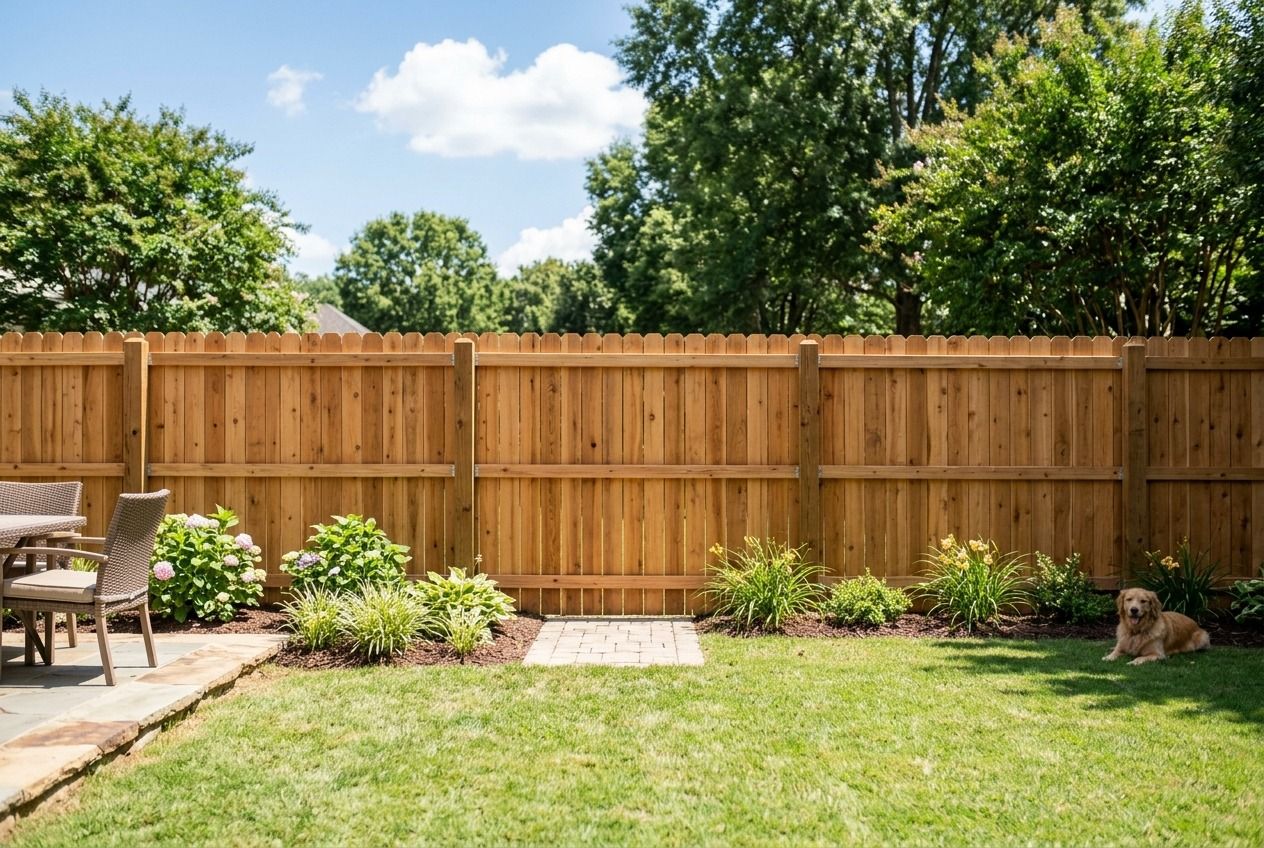
- Water Shedding Dynamics: The angled corner notches prevent rainwater from pooling on the vulnerable end-grain of the pickets, encouraging rapid runoff and reducing top-edge checking.
- Neighborhood Harmony: The dog-ear profile is universally approved by Homeowners Associations (HOAs) throughout Mecklenburg, Union, and York counties.
- Terrain Adaptability: Dog-ear fences can be effortlessly racked or stepped to accommodate rolling hills and uneven grades without leaving unsightly stepped gaps along the ground line.
2. Flat-Top Privacy with Cap-and-Trim
For upscale transitional homes, modern farmhouses, and historic estates, our flat-top cap-and-trim profile turns a standard boundary fence into a prominent architectural feature.
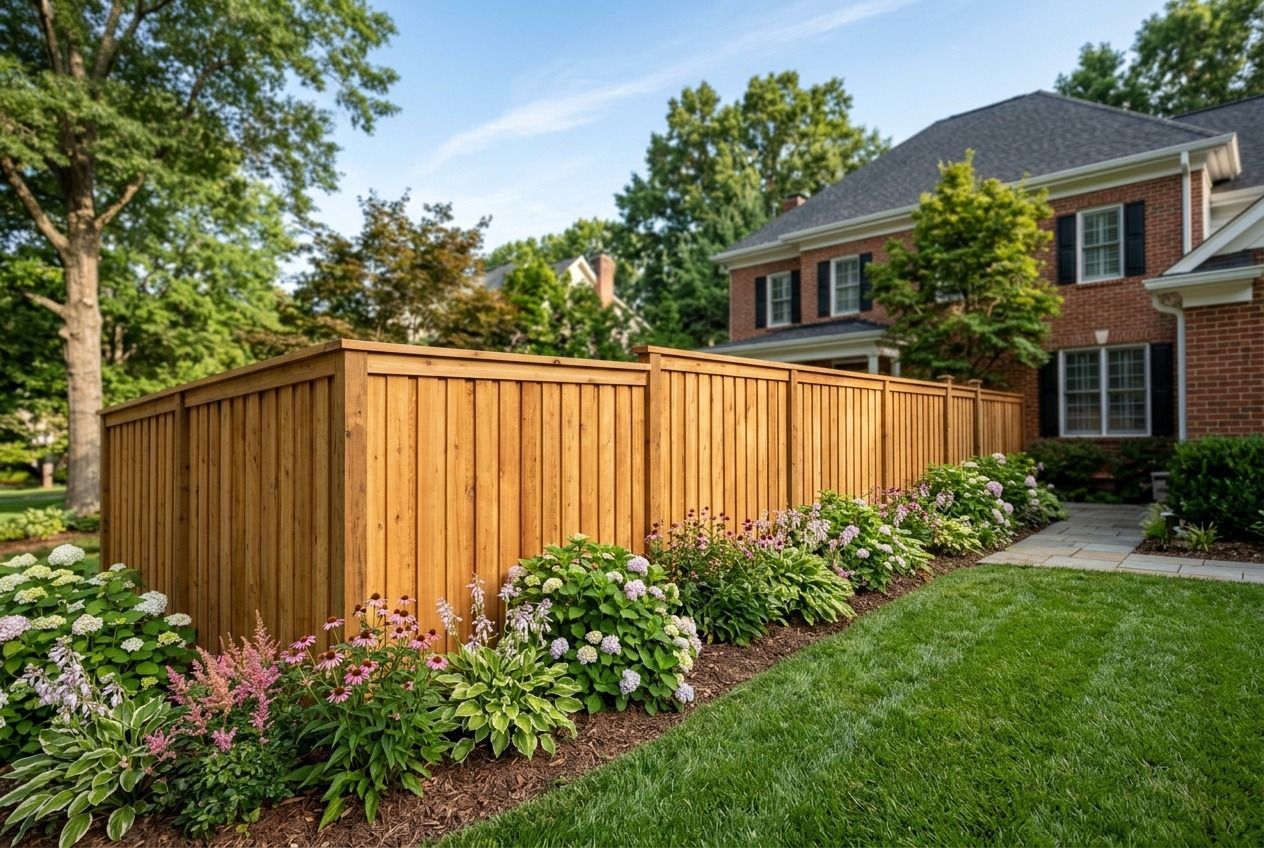
- Integrated Top Cap (2x6 Rail): A horizontal 2x6 lumber plate is mounted across the top of all pickets and posts. This top cap acts as an umbrella, shielding the exposed end-grain of every picket from sun rot, standing rainwater, and fungal decay.
- Fascia Trim (1x4 Moulding): A horizontal 1x4 face plate is nailed directly below the cap rail, concealing picket top fasteners and creating clean, shadow-line horizontal framing.
- Refined Curb Appeal: This finish gives the fence a substantial, furniture-grade appearance that pairs exceptionally well with brick exteriors, stone patios, and landscaped gardens.
Carolina Piedmont Engineering: Wind Sail & Cecil Red Clay
Building a solid privacy fence in Charlotte requires specialized structural considerations that open picket or split-rail fences do not demand. Because solid vertical pickets form an impenetrable surface, a 6-foot privacy fence behaves like a massive wind sail during severe Carolina thunderstorms and tropical storm remnants.
Countering Wind Shear with Heavy-Duty Post Settings
Standard contractor installations often dig shallow 18-inch post holes and use minimal concrete, causing solid fences to tilt or blow over within 3 to 5 years. Amour Fence engineers every run for maximum wind resistance:
- 30 to 36-Inch Footing Depths: We bore post holes deep into undisturbed subsoil, extending well below topsoil and freeze-thaw layers.
- High-Density Cecil Clay Stabilization: The native red clay of the Charlotte Piedmont expands drastically when wet and shrinks into concrete-like fissures during July droughts. We backfill footings with high-strength structural concrete flared at the bottom to lock into the clay wall.
- Crushed Gravel Drainage Footing: Before setting posts and pouring concrete, we place a 3-inch layer of crushed gravel at the base of every hole. This prevents the bottom of the wooden post from standing in trapped subterranean water, halting premature post rot at the foundation.
- Three Structural 2x4 Runners: Many builders cut costs by using only two horizontal rails on a 6-foot fence. We mandate three full 2x4 horizontal rails (top, middle, and bottom) across every 8-foot bay to prevent the pickets from bowing, cupping, or pulling loose under wind pressure.
Choosing Your Lumber: Western Red Cedar vs. Pressure-Treated Pine
Your privacy fence can be built entirely from sustainably harvested Western Red Cedar, high-density Pressure-Treated Southern Yellow Pine, or a hybrid combination:
| Western Red Cedar (Above Ground) | Pressure-Treated Pine (Foundation & Posts) |
|---|---|
| • Natural thujaplicin oils resist insects and decay | • Micronized copper preservative treatment (MCA) |
| • Minimal seasonal shrinkage, warping, or cupping | • Heavy structural density and impact resistance |
| • Rich natural amber-rose grain with fine texture | • Economical upfront material investment |
| • Built-in rot resistance without chemical treatment | • Requires 60-day dry time before staining |
| • #1 Recommended for tight edge-to-edge privacy | • Outstanding durability for direct ground contact |
Premium Western Red Cedar
Grown in the Pacific Northwest, Western Red Cedar is nature’s premier outdoor timber. Cedar contains natural extractives called thujaplicins, which render the wood naturally toxic to wood-decaying fungi and subterranean termites without synthetic chemical treatments. Cedar boasts a tiny shrinkage coefficient, meaning pickets butt tightly against each other with minimal risk of warping or developing wide seasonal sightline gaps.
Heavy-Duty Pressure-Treated Pine
Pressure-Treated Southern Yellow Pine is the workhorse of Southern construction. Treated under high pressure with micronized copper azole (MCA), pine is engineered for direct ground contact. While heavier and more prone to minor surface checking during summer heat seasoning, treated pine offers exceptional structural stiffness and an economical price point.
The Craftsman Hybrid Strategy: Many Charlotte homeowners choose our hybrid build—combining heavy-duty 4x4 or 6x6 pressure-treated pine posts embedded in concrete with Western Red Cedar horizontal rails, vertical pickets, and gates. This delivers maximum foundation longevity with the refined beauty and dimensional stability of cedar above ground.
Precision Gate Engineering & Sag-Free Hardware
A privacy fence is only as reliable as its access gates. Because solid wood privacy gates carry substantial weight, poorly constructed gates quickly drag across lawns, bind against latch posts, and fail to latch securely.
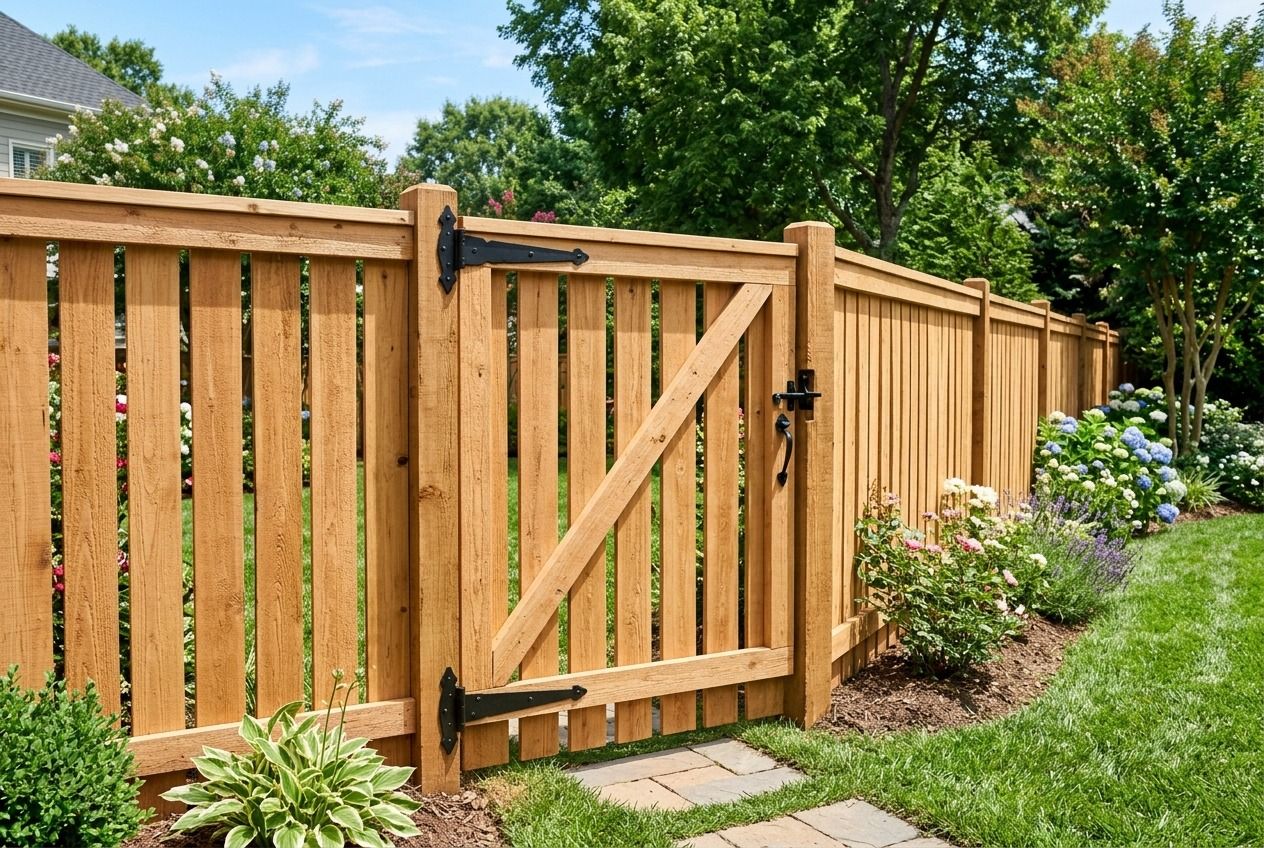
How Amour Fence Builds Indestructible Privacy Gates
- Diagonal Compression Z-Bracing: Every gate frame is built with rigid internal 2x4 framing, including a structural diagonal brace directed from the lower hinge corner upward to the latch-side corner. This compression triangle permanently prevents gravity-induced diagonal sag.
- Heavy-Duty Powder-Coated Hardware: We mount commercial-grade, multi-hole T-hinges and strap hinges anchored into the post with structural lag screws, not weak drywall screws.
- Self-Latching Gravity Catches: Outfitted with positive-locking exterior latches and padlock-compatible eyelets, keeping your backyard secure and compliant with local swimming pool barrier codes.
- Dedicated 6x6 Gate Posts: On wider gate spans (4 feet to 6 feet wide), we upgrade the hinge post to a heavy-duty 6x6 timber post sunk 36 inches deep to absorb dynamic swing torque without deflecting.
Charlotte UDO Zoning Ordinances & HOA Guidelines
Installing a privacy fence in Charlotte, Mecklenburg County, or nearby municipalities requires compliance with the City of Charlotte Unified Development Ordinance (UDO) and neighborhood covenants:
- Rear & Side Yard Height Limits: Under the Charlotte UDO, residential privacy fences can reach up to 6 feet in height in established rear and side yards without requiring a building permit or zoning variance. Fences exceeding 6 feet (such as 8-foot estate privacy fences) require formal municipal approval and HOA variance.
- Front Yard Setbacks: Any fence built forward of the primary front building façade is limited to a maximum height of 4 to 5 feet and typically must maintain open visibility (such as a Traditional Picket Fence). Solid privacy fences cannot be placed within the required front yard setback.
- The “Good Neighbor” Mandate: When building along property boundaries, Charlotte code and virtually all HOA covenants dictate that the “finished” face of the fence (the clean side with pickets exposed) must face outward toward neighboring parcels, public rights-of-way, and streets. The structural rails and posts face inward toward your yard.
- Architectural Review Committee (ARC) Assistance: If your home is situated in a covenant-controlled subdivision like Ballantyne, Highland Creek, Baxter Village, or Providence Plantation, we provide detailed architectural diagrams, material specifications, and elevation drawings to help you secure swift HOA approval before installation.
Transparent Pricing & Workmanship Warranty
At Amour Fence, we believe in straightforward, upfront pricing without high-pressure sales tactics or subcontracting markups:
- Backed by Our 3-Year Limited Workmanship Warranty: Every new privacy fence we build is backed by our 3-Year Limited Workmanship Warranty, covering structural framing integrity, post plumb stability, and gate alignment under normal residential use.
- Transparent Written Proposals: Every estimate clearly details linear footage, post spacing, lumber grade, and hardware. Check regional cost parameters anytime using our Interactive Fence Cost Calculator.
- Neodymium Magnetic Yard Sweep: Following every installation, our crews perform a meticulous clean-up, including wood scrap disposal and a high-strength magnetic sweep across your lawn and driveway to collect stray fasteners.
Frequently Asked Questions About Privacy Fencing
How much privacy does a solid wood fence provide?
A newly installed solid board privacy fence provides 100% complete visual blockage. When pickets are installed edge-to-edge, there are zero sightlines into your outdoor living space. Over time, as natural lumber seasons and undergoes minor seasonal shrinkage, slight hairline expansion gaps (1/16" to 1/8") may develop between boards. Homeowners seeking permanent zero-gap privacy under extreme weather conditions should consider our Board-on-Board Fence design.
Do I need a permit to install a 6-foot privacy fence in Charlotte, NC?
In the City of Charlotte and unincorporated Mecklenburg County, standard residential privacy fences up to 6 feet in height located in rear and side yards do not require a municipal building permit. However, if your fence design exceeds 6 feet in height (such as an 8-foot estate privacy fence), borders a designated public right-of-way, or is governed by an HOA covenant, formal architectural review and municipal permits or variances are required before breaking ground.
How deep do privacy fence posts need to be set in Carolina red clay?
Because a 6-foot solid privacy fence experiences significant wind resistance during storms, post holes must be excavated 24 to 36 inches deep (at least one-third of the total post length). In Charlotte’s dense Cecil red clay, anchoring posts with commercial-grade concrete over a gravel drainage base ensures the fence will not tilt, heave, or pull loose during seasonal moisture cycles.
Should I choose Western Red Cedar or Pressure-Treated Pine for my privacy fence?
Western Red Cedar is the premier choice for homeowners seeking dimensional stability, rich wood grain, and minimal board warping or shrinkage. Pressure-treated pine is a durable, cost-effective option with high structural density, though it requires a longer seasoning period before staining. Many clients opt for a hybrid solution: treated pine posts for heavy ground-contact strength, paired with cedar pickets and rails for superior aesthetics above ground.
How soon should I stain my new wood privacy fence after installation?
If your fence is constructed from Western Red Cedar, you can apply a penetrating oil-based stain after 30 to 60 days, as soon as the surface moisture content measures below 15%. If your fence is built with pressure-treated pine, the lumber retains waterborne preservatives and should season for 60 to 90 days under warm sunlight before applying a professional stain or protective sealant. Learn more about our professional Fence Staining & Treatment Services.
Ready to Design Your Custom Wood Privacy Fence?
Transform your backyard into a peaceful, secure private sanctuary. Contact Sergei and the craftsmen at Amour Fence today for a prompt, complimentary on-site consultation and laser measurement.
- Call or Text: (980) 300-1047
- Direct Email: amourfence@gmail.com
- Explore Our Work: Browse all Custom Architectural Fence Styles or calculate your estimate with our Interactive Cost Calculator.