
Quick Answer: What Fence Lasts the Longest?
Metal fences (wrought iron, aluminum) last the longest overall at 40 to 70+ years. Among wood fences, the clear winner is Western Red Cedar at 20 to 30+ years with proper maintenance — outperforming pressure-treated pine, redwood, and every untreated softwood. In Charlotte NC's humid Piedmont climate, fence material choice matters even more: moisture-retentive red clay soil, 44+ inches of annual rainfall, and active subterranean termite colonies accelerate decay in inferior species by 30 to 50 percent compared to drier regions.
“What fence lasts the longest?” is one of the most searched fencing questions — and one of the most poorly answered. Most guides list every material from chain-link to wrought iron with generic lifespan ranges, ignoring the single factor that matters most: your local climate and soil conditions.
A fence that lasts 30 years in arid Arizona may rot through in 12 years in the Carolina Piedmont. At Amour Fence, we build exclusively with wood in the Greater Charlotte metro, and we have learned precisely how long each timber species survives in our red clay and humid summers.
This guide compares every major fence material by realistic lifespan, then focuses on what Charlotte homeowners actually need to know.
Fence Material Lifespan Comparison
Before diving into specifics, review the complete lifespan landscape across all residential fence materials:
| Fence Material | Expected Lifespan | Maintenance Level | Rot / Insect Resistance | Charlotte Climate Rating |
|---|---|---|---|---|
| Wrought Iron | 50 – 100+ Years | High (rust prevention) | Immune | ★★★★☆ |
| Aluminum | 40 – 70 Years | Very Low | Immune | ★★★★★ |
| Vinyl (PVC) | 20 – 30 Years | Very Low | Immune | ★★★★☆ |
| Composite (WPC) | 25 – 40 Years | Low | Immune | ★★★★☆ |
| Western Red Cedar | 20 – 30+ Years | Moderate (stain every 2–3 yrs) | Natural thujaplicin oils | 🏆 ★★★★★ |
| Redwood | 20 – 30 Years | Moderate | Natural tannins | ★★★★☆ |
| Pressure-Treated Pine | 15 – 25 Years | Moderate–High | Chemical (MCA biocide) | ★★★★☆ |
| Untreated Pine / Spruce | 4 – 8 Years | N/A (fails too fast) | None | ❌ ★☆☆☆☆ |
| Chain Link (Galvanized) | 15 – 25 Years | Low | Immune | ★★★☆☆ |
For a deep dive into which wood species to avoid entirely, see our guide on Woods to Avoid for Fencing.
Wood Fence Lifespans: The Complete Breakdown
Metal and vinyl dominate the raw longevity charts, but wood remains the preferred fence material for Charlotte homeowners who value natural aesthetics, neighborhood character, and HOA compliance. Here is how the three viable wood species perform in the Carolinas.
Western Red Cedar: 20 to 30+ Years
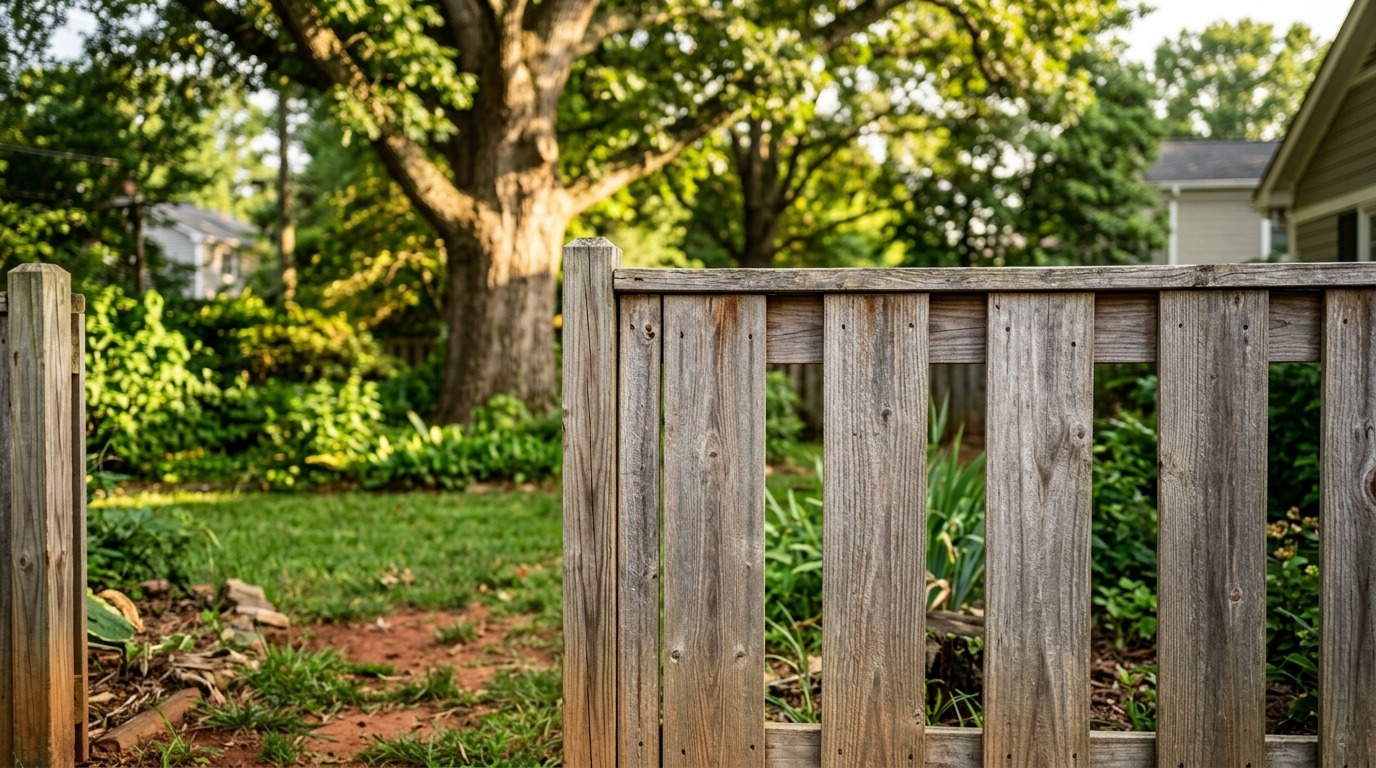
Western Red Cedar (Thuja plicata) is the benchmark wood fence material for longevity. Its heartwood contains concentrated thujaplicin oils — natural fungicides and insect repellents produced by the tree over centuries of growth in the Pacific Northwest rainforest.
These extractives deliver three critical advantages in Charlotte’s climate:
- Fungal Resistance: Thujaplicins actively inhibit the brown-rot and white-rot fungi that thrive in humidity above 80%.
- Termite Deterrence: The aromatic oils are naturally unpalatable to subterranean termites — Charlotte’s most destructive wood pest.
- Dimensional Stability: Cedar shrinks and warps less than any other common fence wood, keeping pickets straight through humid summers and dry winters.
With penetrating oil stain applied every 2 to 3 years, a heartwood-grade cedar fence routinely reaches 25 to 30 years in the Charlotte metro. Left completely unstained, cedar weathers to an elegant silver-gray patina and still lasts 18 to 22 years above ground.
For detailed cedar care protocols, read our Cedar Fence Maintenance Guide.
Pressure-Treated Pine: 15 to 25 Years
Pressure-treated Southern Yellow Pine uses Micronized Copper Azole (MCA) preservatives forced deep into the wood fibers under industrial pressure. This chemical treatment makes pine highly resistant to fungal decay and moderately resistant to termites.
In Charlotte, treated pine excels as ground-contact post material (rated UC4A for direct burial) but has limitations for above-ground pickets:
- High Shrinkage: Pine shrinks 6 to 8 percent tangentially as it dries, creating gaps between pickets within the first 12 months.
- Cupping and Twisting: Pine flat-sawn pickets cup and twist more aggressively than cedar in the Piedmont’s wet-dry cycling.
- Frequent Staining Required: Treated pine demands stain within the first year of installation and re-application every 2 to 3 years to prevent UV graying and surface checking.
Despite these drawbacks, properly maintained pressure-treated pine posts anchored in concrete easily reach 20 to 25 years in Charlotte’s red clay — making them the standard structural foundation.
Learn more on our Pressure-Treated Pine materials page.
Redwood and Cypress: 20 to 30 Years (Limited Availability)
Both Redwood and Bald Cypress contain natural decay-resistant heartwood comparable to cedar. However, neither is a practical option for most Charlotte homeowners:
- Redwood: Harvested almost exclusively in Northern California. Freight costs to the Carolinas add significantly to project budgets, and local lumberyards rarely stock fence-grade redwood.
- Bald Cypress: Native to the Southeast but increasingly scarce in commercial fence dimensions. Old-growth heartwood is superb; second-growth sapwood rots nearly as fast as untreated pine.
For a full comparison, see our Cedar vs. Redwood Fence analysis.
Non-Wood Fencing: How Metal, Vinyl, and Composite Compare
While Amour Fence specializes in wood, homeowners should understand where non-wood materials fit in the longevity spectrum:
Aluminum (40–70 years) — Cannot rust, requires no painting, and handles Charlotte’s humidity effortlessly. Excellent for decorative and pool fences. Offers zero privacy.
Vinyl / PVC (20–30 years) — Immune to rot and insects. Requires only occasional washing. However, vinyl panels cannot be repaired board-by-board; a single cracked section means replacing the entire panel. Lower-grade vinyl yellows and becomes brittle under sustained UV exposure.
Wrought Iron (50–100+ years) — The ultimate in raw longevity but demands rust-preventive coating every 3 to 5 years. Extremely heavy and expensive. Offers no privacy.
Composite (WPC) (25–40 years) — Blends recycled wood fibers with plastic polymers. Resists rot and insects without staining. Higher upfront cost than wood or vinyl.
The Charlotte Climate Factor: Why Location Changes Everything
National lifespan averages are misleading for Charlotte homeowners. Three regional conditions accelerate fence deterioration well beyond what homeowners in drier or cooler climates experience:
Red Clay Soil Traps Moisture at the Post Base
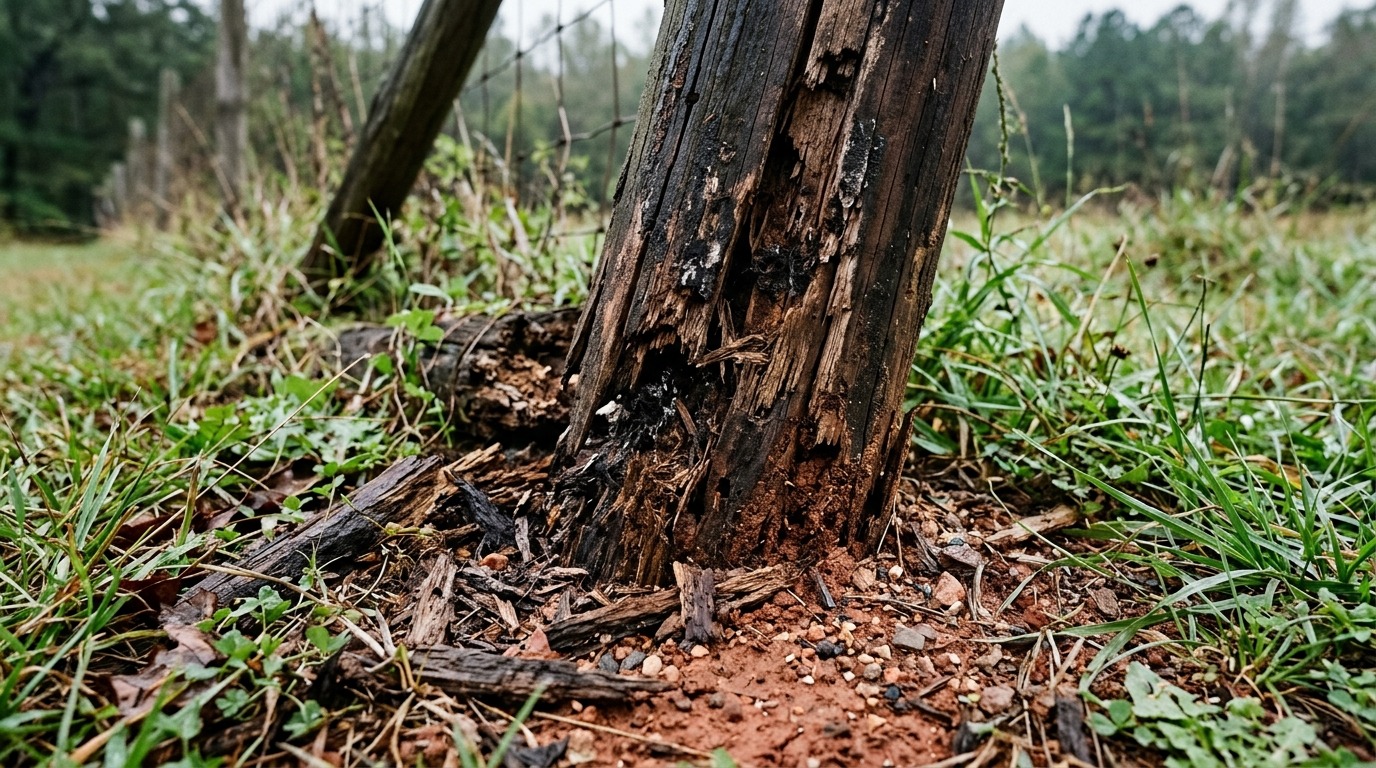
Charlotte sits on a deep bed of Piedmont red clay — a dense, mineral-rich soil that drains poorly and retains moisture against fence posts for weeks after rainfall. A post set directly in red clay without proper drainage sits in a near-permanent moisture bath, accelerating rot at the critical groundline zone.
Subtropical Humidity Fuels Fungal Growth
Charlotte averages 80%+ relative humidity during June through September. Wood fiber above 20% moisture content enters the fungal activation zone — the threshold where brown-rot, white-rot, and surface mildew can colonize untreated timber. Species without natural extractives or chemical preservatives begin decaying within 12 months of installation.
Subterranean Termites Attack from Below
The Carolina Piedmont is a high-pressure zone for Eastern Subterranean Termites (Reticulitermes flavipes). These colonies build mud shelter tubes from soil directly onto fence posts and can consume untreated softwood at a rate that compromises structural integrity within 3 to 5 years.
Ground Contact vs. Above Ground: Where Fences Actually Fail
Understanding where on a fence decay occurs is just as important as knowing which material to use. A fence does not rot uniformly — it fails at specific stress points:
FENCE FAILURE ZONES — WHERE DECAY CONCENTRATES
────────────────────────────────────────────────────────────
Zone 1: GROUNDLINE (0–6" above/below grade)
         ► 75% of all structural failures originate here
         ► Moisture, clay contact, termite entry point
         ► Solution: UC4A treated pine + gravel drainage

Zone 2: BOTTOM RAIL (6–12" above grade)
         ► Splash-back zone from rain and irrigation
         ► Trapped moisture behind pickets
         ► Solution: Cedar or treated rail, 2" ground gap

Zone 3: POST CAP (Top)
         ► Standing water pools on flat-cut post tops
         ► Accelerates top-down rot into the post core
         ► Solution: Beveled or capped post tops
────────────────────────────────────────────────────────────
This is precisely why the Hybrid Wood Fence System — combining UC4A pressure-treated pine posts for ground contact with Western Red Cedar pickets and rails above grade — delivers the best longevity-per-dollar for Charlotte homeowners. Each material is deployed exactly where its biological strengths matter most.
For the full wood selection framework, see our Best Wood for a Fence Guide.
5 Installation Practices That Add 10+ Years to Any Fence
Material selection accounts for roughly half of a fence’s lifespan. The other half is engineering and installation quality. These five practices, standard on every Amour Fence installation, can add a decade or more of service life:
Set Posts 30–36 Inches Deep in Concrete: Posts must extend below Charlotte’s frost line (approximately 12 inches) and deep enough into stable subsoil to resist lateral wind loads and clay heave.
Install a 4-Inch Gravel Drainage Bed: Beneath every concrete footing, a layer of crushed gravel allows groundwater to drain away from the post base rather than pooling in dense red clay.
Specify Heartwood-Only Cedar Pickets: Sapwood — the pale outer ring of the log — contains zero protective extractives and rots 3 to 5 times faster than heartwood. Every picket should be inspected for sapwood content before installation.
Use Stainless Steel or Hot-Dipped Galvanized Fasteners: Electro-galvanized nails rust within 2 years in Charlotte humidity and create black tannin stains on cedar. Ring-shank stainless steel fasteners eliminate both problems.
Apply Penetrating Oil Stain Within 6 Months: A penetrating oil-based stain (not a film-forming paint) blocks UV degradation while allowing the wood to breathe. Re-apply every 2 to 3 years for maximum lifespan.
Build a Fence Designed to Last a Generation
Every fence material has a finite lifespan — but the right combination of species, engineering, and maintenance pushes that limit decades further. At Amour Fence, we build exclusively with premium Western Red Cedar and structural-grade pressure-treated pine, engineered specifically for Charlotte’s demanding climate.
Your fence should outlast your mortgage. Let us show you how.
Ready to Build the Longest-Lasting Wood Fence in Charlotte?
- Call Our Craftsmen Directly: (980) 300-1047
- Schedule an On-Site Consultation: Get a Free Estimate
- Our Charlotte Service Areas: Serving Charlotte, Matthews, Pineville, Waxhaw, Weddington, Fort Mill, Indian Trail, Mint Hill, and surrounding Mecklenburg and Union County neighborhoods.
Frequently Asked Questions
What type of fence lasts the longest?
Under ideal conditions, wrought iron and aluminum fences can exceed 50 years. Among wood fences, Western Red Cedar lasts 20 to 30 years above ground with periodic stain maintenance, making it the longest-lasting wood fence material. In Charlotte's humid Piedmont climate, cedar outperforms every other residential wood species because its natural thujaplicin oils resist both fungal decay and subterranean termite damage without chemical treatment.
How long does a wood fence last in Charlotte NC?
Wood fence lifespan in Charlotte depends heavily on the species and installation quality. Untreated pine or spruce fences fail in 5 to 8 years due to moisture-retentive red clay soil, high summer humidity, and active termite colonies. Pressure-treated Southern Yellow Pine posts last 15 to 25 years in ground contact. Western Red Cedar pickets and rails last 20 to 30 years above ground with staining every 2 to 3 years.
Does vinyl fencing last longer than wood?
Vinyl (PVC) fencing typically lasts 20 to 30 years with minimal maintenance, which is comparable to well-maintained cedar. However, vinyl becomes brittle under prolonged UV exposure and cannot be repaired board-by-board like a wood fence. In Charlotte's intense summer sun, lower-grade vinyl panels can crack and yellow within 15 years. A properly maintained Western Red Cedar fence matches or exceeds vinyl lifespan while offering superior aesthetics and individual-board repairability.
What is the best fence material for humid climates?
For humid subtropical climates like Charlotte NC, Western Red Cedar is the best wood fence material. Its cellular structure contains natural thujaplicin fungicides that actively resist the mold, mildew, and brown-rot fungi that thrive in 80%+ humidity. For non-wood options, aluminum and vinyl both resist moisture damage effectively but lack the natural warmth and curb appeal of real wood.
How can I make my wood fence last longer?
Five practices significantly extend wood fence lifespan in Charlotte: (1) use UC4A pressure-treated pine for ground-contact posts, (2) set posts at least 30 inches deep in concrete below the frost line, (3) install a 4-inch gravel drainage bed beneath the concrete footing to prevent water pooling in red clay, (4) choose 100% heartwood Western Red Cedar for pickets and rails, and (5) apply a penetrating oil-based stain every 2 to 3 years to block UV degradation and moisture absorption.