
Quick Answer: What Are the Main Types of Wood Fence Designs?
Choosing among the primary types of wood fence designs requires balancing sightline privacy, wind airflow, and neighborhood architectural compliance. While solid board and board-on-board styles deliver complete privacy, shadowbox fences provide semi-privacy with superior storm airflow and HOA acceptance, modern horizontal styles deliver contemporary lines, and picket or split rail designs establish open property boundaries.
When planning a residential perimeter, homeowners frequently focus on lumber species while overlooking panel architecture. Yet the orientation, spacing, and construction of your pickets dictate how your fence endures summer thunderstorms, whether your Homeowners Association (HOA) approves your project, and how effectively your backyard is shielded from view.
In the Charlotte metro area—from established neighborhoods like Myers Park to growing communities across Matthews, Huntersville, and Fort Mill—selecting the right structure ensures lasting curb appeal and structural stability.
At Amour Fence, we custom-build every panel on-site. Below is our comprehensive architectural guide to the primary wood fence design ideas and styles built for North Carolina properties.
Master Wood Fence Style Comparison
Here is how the six leading types of wood fences compare across privacy, wind resistance, HOA compliance, and local performance:
| Fence Style | Privacy Level | Wind Airflow | Charlotte HOA Status | Visual Profile | Best Local Application |
|---|---|---|---|---|---|
| Solid Board Privacy | 90%–95% (minor gaps post-dry) | Low (full sail effect) | Standard (finished face out) | Clean, solid barrier | Perimeter security, suburban yards |
| Board-on-Board | 100% (zero sightlines) | Low (solid barrier) | Highly favored | Deep shadow lines, dimensional | Patios, pools, tight property lines |
| Shadowbox | 80%–85% (semi-private) | High (30%–40% flow) | 🏆 Best (true Good Neighbor) | Identical two-sided symmetry | Storm-prone flat lots, shared lines |
| Modern Horizontal | 95%–100% (custom reveals) | Moderate | Requires review | Contemporary clean lines | Modern homes, outdoor living |
| Classic Picket | 20%–40% (open boundary) | Maximum (unrestricted) | Universally permitted | American cottage charm | Front yards, gardens, pet borders |
| Split Rail with Wire | Open (transparent mesh) | Maximum (zero drag) | Standard on large parcels | Rustic, pastoral | Wooded perimeters, Waxhaw acreage |
1. Solid Board Privacy Fence: The Traditional Benchmark
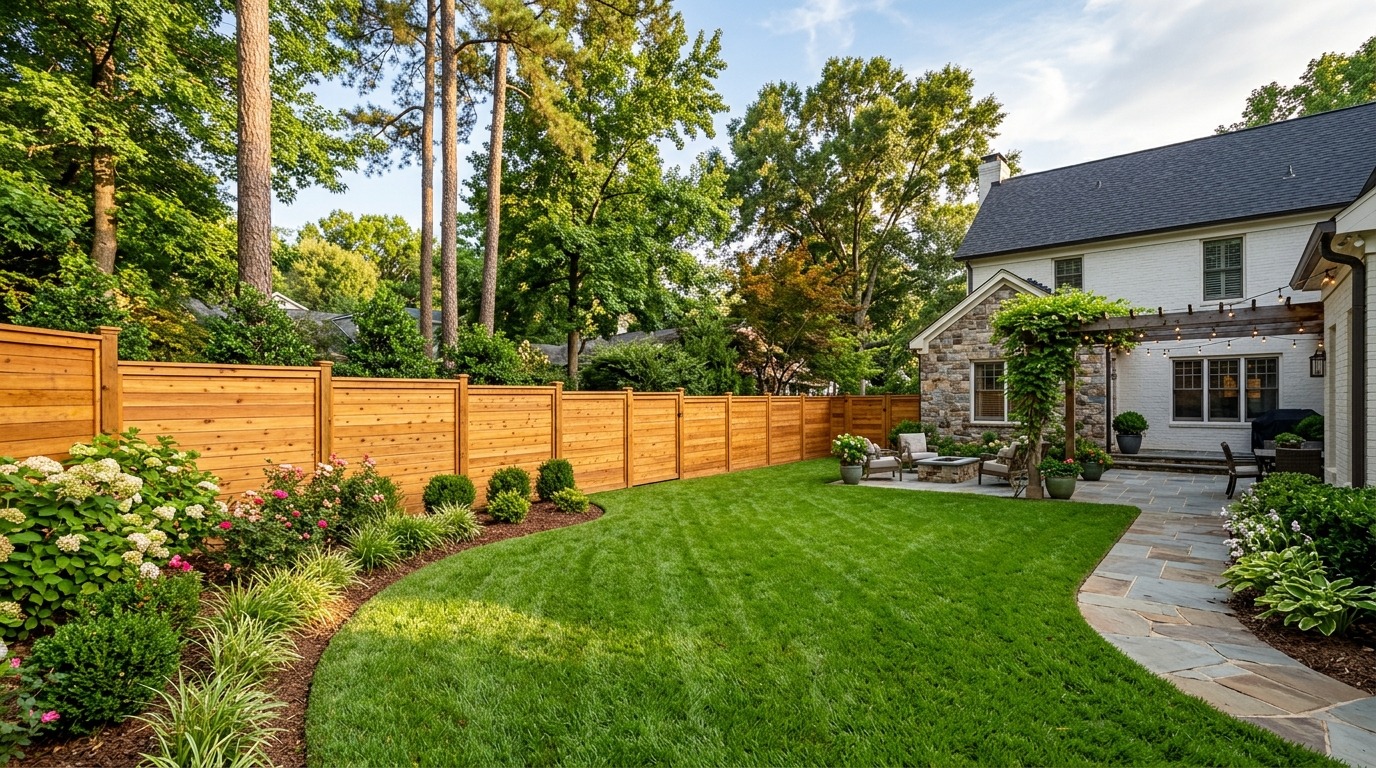
The solid board privacy fence remains the classic suburban standard across the Carolinas. In this configuration, vertical pickets (typically 1x6 inch boards) are fastened flush edge-to-edge directly to horizontal framing rails.
Key Architectural Strengths
- Clean Visual Uniformity: Solid board panels present an uninterrupted vertical wall from outside viewpoints, complementing traditional neighborhood architecture.
- Sound Attenuation: The solid wooden barrier dampens street noise, lawnmowers, and neighbor activity.
- Cost-Efficient Coverage: Solid board requires fewer board feet of lumber than overlapping designs, making it budget-conscious for large perimeters.
Engineering Realities in Charlotte
- The “Sail Effect”: Solid panels catch strong storm winds like a ship’s sail. In wet Carolina red clay, high wind loads exert heavy leverage on support posts. Solid installations require deep, well-anchored concrete footings to resist leaning.
- Shrinkage Gaps: When wet lumber dries in hot Piedmont summers, boards shrink slightly, revealing 1/8-inch hairline gaps between pickets over time.
2. Board-on-Board Fence: Zero-Gap Complete Privacy
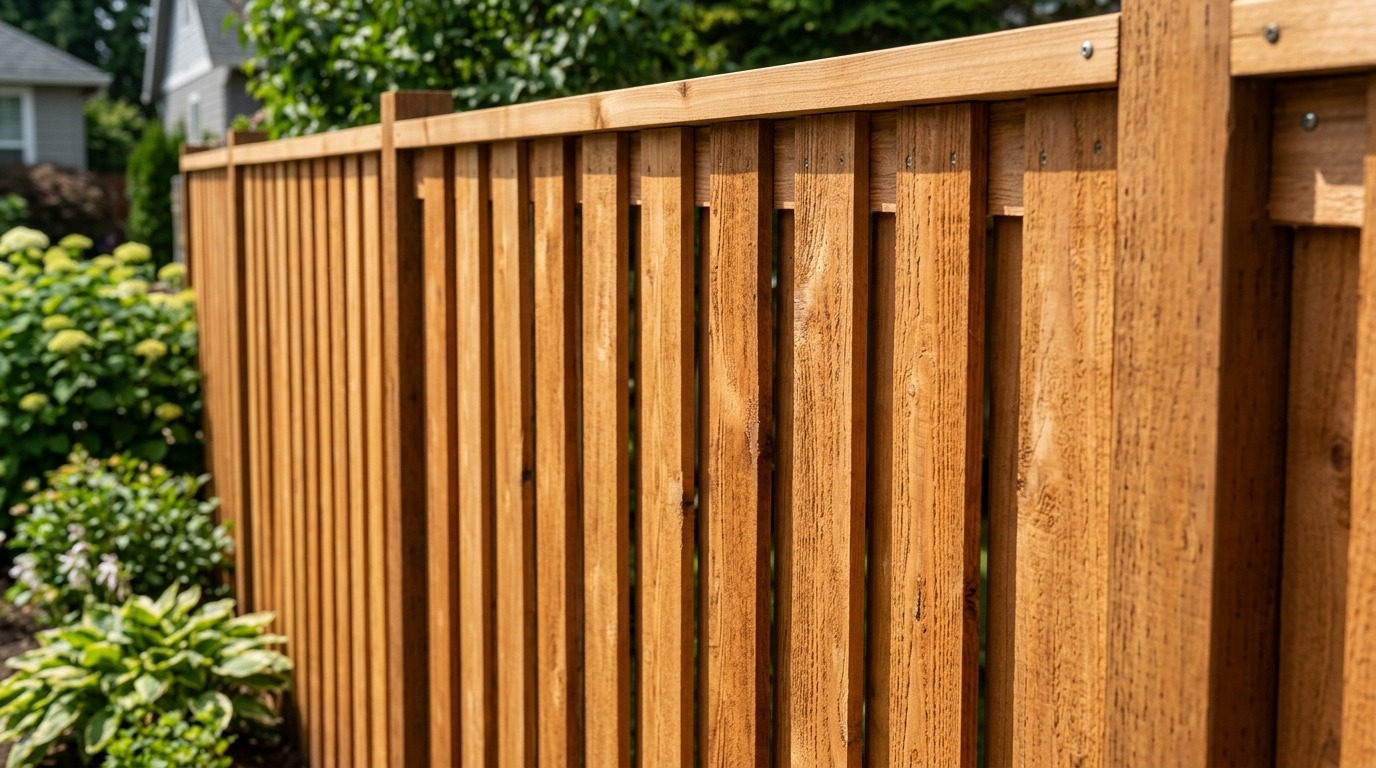
Homeowners desiring complete privacy choose the board-on-board fence style. Rather than placing pickets edge-to-edge, this design layers boards in an overlapping arrangement with a 1-inch to 1.5-inch overlap.
Why Board-on-Board Solves Common Privacy Flaws
- True Year-Round Seclusion: As lumber expands in humid weather and contracts in winter, the overlapping boards conceal all sightlines. Direct views into your yard remain blocked in every season.
- Architectural Depth: The layered boards cast deep vertical shadow lines, giving the fence panel a heavy, premium appearance.
- Rigid Construction: The interlocking double layer of timber reinforces panel strength against wind and perimeter activity.
Because board-on-board uses roughly 25% more lumber than a single-layer fence, it carries extra weight. We set structural posts at least 36 inches deep into native clay to ensure lifetime alignment.
3. Shadowbox Fence: The Ultimate “Good Neighbor” Design
Property boundary fencing often creates disagreements over which neighbor receives the finished face versus the framing side. The shadowbox fence completely eliminates this issue.
In a shadowbox design, vertical pickets alternate on opposing sides of the horizontal rails in a staggered pattern, producing an identical finished appearance on both sides.
The Aerodynamic Advantage
- Storm-Resistant Airflow: The staggered picket spacing allows 30% to 40% open airflow directly through the fence panel.
- Protecting Post Footings: During intense Piedmont summer squalls, wind passes through the panel rather than slamming into an immovable wall. This dramatic reduction in wind resistance spares post footings from rotational torque when surrounding red clay is waterlogged.
Visual Privacy & HOA Approval
When viewed directly, shadowbox fences appear nearly solid. At sharp angles, sightlines open slightly to allow ambient light and cross-breezes. Because both sides look finished, Homeowners Associations across South Charlotte, Ballantyne, and Matthews widely recommend shadowbox fencing for shared lot lines.
4. Modern Horizontal Wood Fence: Contemporary Clean Lines
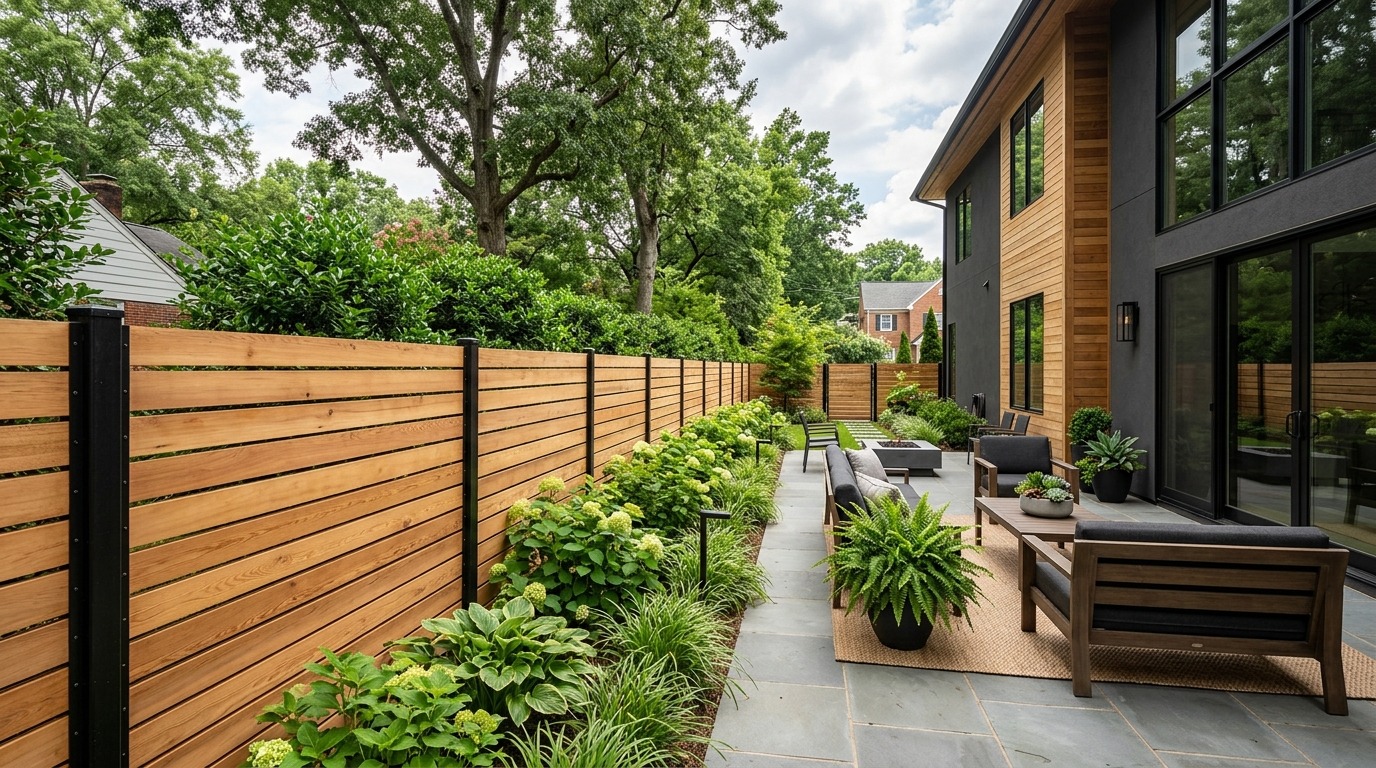
The modern horizontal wood fence is the preferred design for modern, craftsman, and transitional residences across the Queen City. Instead of vertical pickets, long lumber boards run horizontally between support posts.
Structural Requirements for Horizontal Design
Horizontal fencing provides striking curb appeal, but improper construction causes rapid structural failure:
- Strict 6-Foot Post Spans: Vertical fences typically space posts 8 feet apart. For horizontal designs, an 8-foot span invites sagging under gravity. Amour Fence restricts horizontal post spans to 6 feet, backed by center vertical braces.
- Lumber Dimensional Stability: Pressure-treated pine frequently twists when mounted horizontally. For crisp lines, Western Red Cedar heartwood is essential. Cedar’s straight grain ensures boards stay flat across every span.
5. Classic Picket Fence: American Heritage Curb Appeal
For front yards, walkways, and historic homes, the traditional wood picket fence provides welcoming charm.
Standing 3 to 4 feet tall with evenly spaced pickets, this design features decorative top profiles:
- Dog-Ear: Classic angled cuts for clean simplicity.
- Colonial Pointed / Gothic: Elegant pointed finials popular on historic properties.
- Flat-Top with Cap: Modern linear profiles with a polished top rail.
Picket fences define property borders, keep dogs and small children securely enclosed, and prevent cut-through foot traffic without walling off neighborhood engagement.
6. Split Rail & Post-and-Rail with Wire Mesh
For large lots and rural properties in Waxhaw, Weddington, and Union County, tall privacy fences look out of scale.
Split rail and post-and-rail fencing deliver an open, rustic perimeter:
- Pastoral Demarcation: Two or three rough-hewn horizontal rails connect into mortised posts, blending naturally with wooded acreage.
- Pet-Safe Wire Mesh: We attach black powder-coated welded wire mesh to the inside rail face. The dark wire visually disappears into the landscape, safely containing dogs while preserving panoramic views.
Navigating Charlotte HOA Rules & Wood Fence Styles
Before starting any fence installation in the Charlotte metro area, reviewing neighborhood covenants and municipal codes is essential.
Local Architectural Review Committees (ARCs) enforce clear standards:
- The Finished Face Rule: When building solid board or board-on-board fences, local HOAs almost universally require the smooth finished side to face outward toward streets and adjacent homes. Shadowbox designs bypass this rule naturally.
- Height Limits: Backyard privacy fences are typically restricted to 6 feet. Front yard fencing cannot exceed 3 to 4 feet and is prohibited forward of the home’s front facade in many subdivisions.
- Materials and Approvals: Most HOAs require ARC design submission before installation. Chain-link is widely banned, while natural cedar and stained wood fences are favored. Always call NC811 for utility marking before digging.
Selecting the Right Timber for Your Chosen Style
A fence design is only as durable as the lumber used to construct it:
Western Red Cedar: Architectural Stability
For board-on-board, horizontal, and shadowbox designs, Western Red Cedar is the premier choice. Naturally infused with organic thujaplicins, cedar repels termites and fungal decay without chemical pressure treatment. Its minimal shrinkage rate prevents cupping, ensuring tight joints and straight panels.
Pressure-Treated Pine: Foundation Strength
Southern Yellow Pine treated to AWPA UC4A standards provides exceptional ground-contact rot resistance for below-grade posts. Many homeowners choose our hybrid approach: durable treated pine posts anchored in concrete, paired with pristine Western Red Cedar rails and face pickets above grade.
For a detailed analysis of lumber properties, explore our guide on Cedar vs. Pressure-Treated Pine Fences.
Frequently Asked Questions
What is the most popular type of wood fence in Charlotte NC?
In Charlotte, 6-foot vertical board-on-board and solid board privacy fences lead backyard installations. However, shadowbox fences are increasingly required in master-planned communities across Ballantyne and Huntersville to satisfy strict HOA “good neighbor” guidelines.
What is a “good neighbor” fence design?
A “good neighbor” fence features an identical finished appearance on both sides. The shadowbox style is the premier example, alternating vertical pickets on either side of the rails so neither neighbor faces an exposed framing structure.
Which wood fence style handles high winds and storms the best?
Shadowbox and spaced picket styles handle high winds best. By alternating pickets, shadowbox panels allow 30% to 40% open airflow, preventing the “sail effect” that destabilizes solid privacy fences in wet Carolina red clay.
Does a horizontal wood fence cost more than a vertical fence?
Yes. Horizontal fences require tighter post spacing (6 feet instead of 8 feet) to prevent sagging, plus premium, dimensionally stable Western Red Cedar to resist bowing across horizontal spans.
What is the difference between solid board and board-on-board privacy fences?
Solid board places pickets edge-to-edge, which can open 1/8-inch gaps as lumber dries. Board-on-board overlaps pickets by 1 to 1.5 inches, maintaining 100% true privacy regardless of seasonal shrinkage.
Choose the Perfect Wood Fence Style for Your Charlotte Home
Selecting the right wood fence design is an investment in your home’s privacy, security, and architectural beauty. From shadowbox airflow to modern horizontal lines, our craftsmen build each fence on-site with premium materials.
At Amour Fence, we tailor every project to your property layout, soil conditions, and HOA requirements for lasting durability.
Ready to Design Your Custom Wood Fence?
- Call Our Master Builders Directly: (980) 300-1047
- Request a Complimentary On-Site Design Consultation: Get a Free Estimate
- Our Piedmont Service Communities: Charlotte, Matthews, Ballantyne, Pineville, Huntersville, Waxhaw, Weddington, Fort Mill, Indian Trail, Mint Hill, and surrounding Mecklenburg and Union County neighborhoods.
Frequently Asked Questions
What is the most popular type of wood fence in Charlotte NC?
In Charlotte, 6-foot vertical board-on-board and solid board privacy fences lead backyard installations. However, shadowbox fences are increasingly required in master-planned communities across Ballantyne and Huntersville to satisfy strict HOA 'good neighbor' guidelines.
What is a 'good neighbor' fence design?
A 'good neighbor' fence features an identical finished appearance on both sides. The shadowbox style is the premier example, alternating vertical pickets on either side of the rails so neither neighbor faces an exposed framing structure.
Which wood fence style handles high winds and storms the best?
Shadowbox and spaced picket styles handle high winds best. By alternating pickets, shadowbox panels allow 30% to 40% open airflow, preventing the 'sail effect' that destabilizes solid privacy fences in wet Carolina red clay.
Does a horizontal wood fence cost more than a vertical fence?
Yes. Horizontal fences require tighter post spacing (6 feet instead of 8 feet) to prevent sagging, plus premium, dimensionally stable Western Red Cedar to resist bowing across horizontal spans.
What is the difference between solid board and board-on-board privacy fences?
Solid board places pickets edge-to-edge, which can open 1/8-inch gaps as lumber dries. Board-on-board overlaps pickets by 1 to 1.5 inches, maintaining 100% true privacy regardless of seasonal shrinkage.