
Quick Answer: Is Cedar or Redwood Better for Fencing?
For homeowners in the Charlotte metropolitan area, Western Red Cedar is the practical and architectural winner over California Redwood. While both softwoods share outstanding 20- to 25-year natural rot resistance, California Redwood incurs steep transcontinental shipping markups from the Pacific Coast and often arrives in lower-tier grades heavy in rot-vulnerable sapwood. Western Red Cedar provides equal durability, a superior strength-to-weight ratio that prevents gate hinge sag, and reliable local availability without West Coast freight penalties.
When selecting lumber for a premium custom wood perimeter fence, homeowners frequently narrow their choice to two premier North American softwoods: Western Red Cedar (Thuja plicata) and California Redwood (Sequoia sempervirens). Both species are renowned for their warm natural beauty, architectural prestige, and natural defense against rot and subterranean termites.
However, choosing fencing materials cannot be done without considering local geography. National building guides often treat cedar and redwood as interchangeable, ignoring regional climate realities. Across Mecklenburg, Union, and York counties, high summer humidity, heavy clay soil, and East Coast supply chains fundamentally alter how these two timbers perform.
In this engineering guide, the craftsmen at Amour Fence examine the mechanical, botanical, and regional realities of cedar versus redwood to help you make an informed investment.
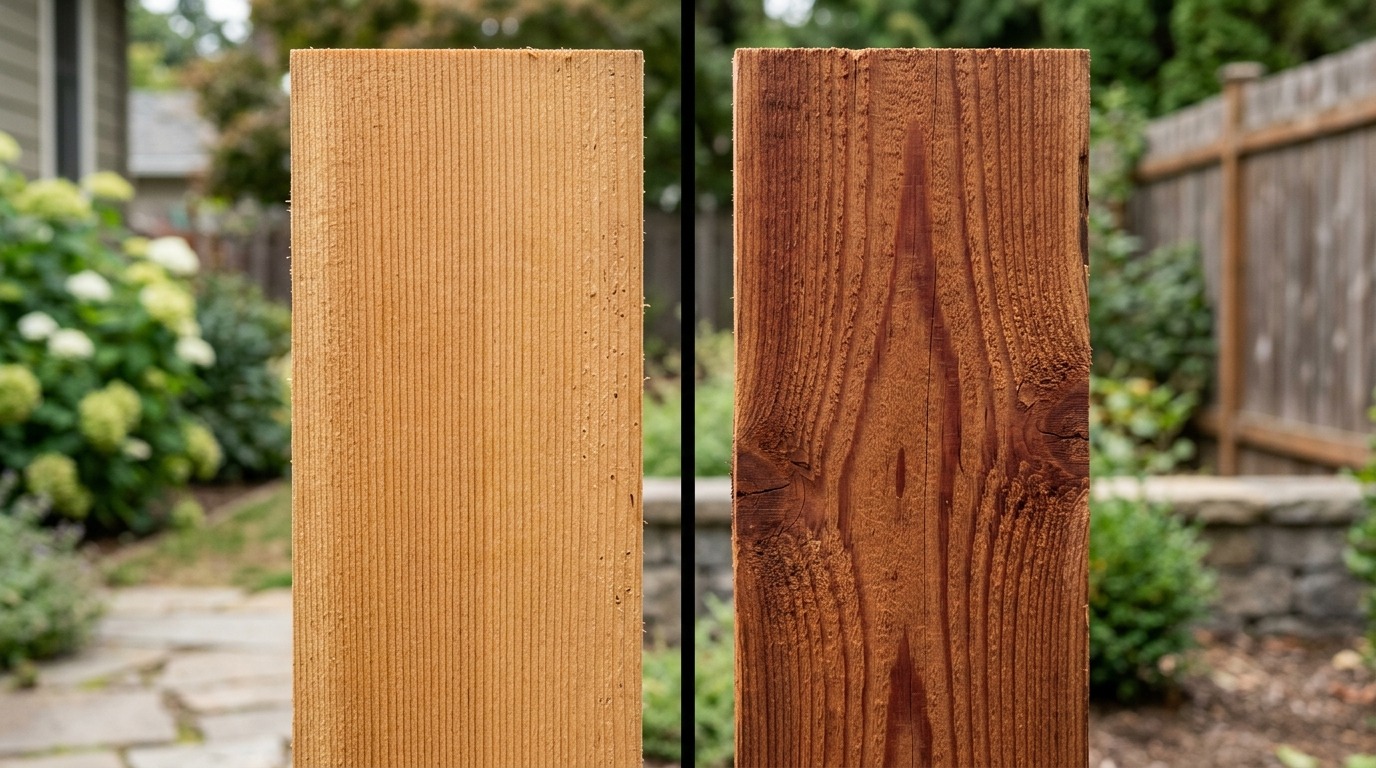
Head-to-Head Comparison: Western Red Cedar vs. California Redwood
The following table summarizes the core technical specifications and regional performance differences between Western Red Cedar and California Redwood:
| Performance Metric | Western Red Cedar (Thuja plicata) | California Redwood (Sequoia sempervirens) | Charlotte Regional Advantage |
|---|---|---|---|
| Native Growing Region | Pacific Northwest & British Columbia | Northern California Coastal Fog Belt | Western Red Cedar (Established East Coast Supply) |
| Janka Hardness Rating | 350 lbf (Soft, resilient, lightweight) | 450 lbf (Firm, moderate dent resistance) | Redwood (+28% surface hardness) |
| Air-Dry Density / Weight | ~21–23 lbs / cu. ft. | ~28–30 lbs / cu. ft. | Western Red Cedar (Significantly less gate sag) |
| Primary Rot Inhibitor | Natural Thujaplicin Extractives | High Natural Tannic Acid Compounds | Tie (Both resist fungal decay naturally) |
| Dimensional Stability | Volumetric Shrinkage: 6.8% (Very Low) | Volumetric Shrinkage: 6.8% (Very Low) | Tie (Minimal warping or cupping) |
| Above-Ground Lifespan | 20 to 25+ Years (All-Heartwood) | 20 to 25+ Years (Con-Heart Grade) | Tie (Equal biological lifespan) |
| East Coast Availability | High (Readily stocked premium grades) | Extremely Limited (Special-order lumber) | Western Red Cedar (Consistent local sourcing) |
| Sapwood Rot Vulnerability | Sapwood decays; graded for heartwood | Sapwood decays; common grades contain it | Western Red Cedar (Higher grade reliability) |
| Required Fasteners | Stainless Steel or Hot-Dipped Galvanized | Stainless Steel or Hot-Dipped Galvanized | Tie (Both require corrosion-proof hardware) |
| Regional Cost Profile | Premium investment, fair contractor rates | Extreme cost premium (Transcontinental freight) | Western Red Cedar (Substantially better value) |
For an overview of how these woods compare against pressure-treated pine and cypress, read our comprehensive Best Wood for a Fence Guide.
Wood Hardness, Weight, and Gate Hardware: The Janka Scale Reality
The first major physical distinction between these two softwoods is fiber density and surface hardness.
On the industry-standard Janka Hardness Scale—which evaluates the force required to embed a 0.444-inch steel ball halfway into the lumber:
- California Redwood rates at approximately 450 pounds-force (lbf).
- Western Red Cedar rates at approximately 350 pounds-force (lbf).
This makes redwood roughly 28% harder than cedar, providing greater resistance against surface dings from lawn equipment or energetic pets. However, increased density introduces a major structural drawback: dead weight.
Why Lumber Weight Causes Gate Sag
California Redwood weighs roughly 28 to 30 pounds per cubic foot, compared to just 21 to 23 pounds per cubic foot for Western Red Cedar. On long perimeter fence panels, this weight difference is manageable. On swinging pedestrian or driveway gates, however, dead weight translates directly into rotational torque on hinge pins and gate posts:
- Redwood Gates: The extra 35% mass accelerates hinge wear. In Charlotte’s damp climate, where wet red clay softens post stability, heavy redwood gates are notoriously prone to diagonal racking, dragging across lawns, and binding against latches unless supported by heavy-duty steel gate frames and oversized posts.
- Western Red Cedar Gates: Cedar offers one of the highest strength-to-weight ratios of any commercial softwood. A cedar gate leaf maintains clean square alignment with minimal downward hinge deflection, ensuring effortless latching for decades.
The Charlotte Supply Chain: Heartwood vs. Sapwood and East Coast Freight
On paper, heartwood redwood and heartwood cedar boast similar 20- to 25-year lifespans. In the real world, regional lumber logistics and grading standards create a massive performance divide.
The Transcontinental Freight Surcharge
California Redwood grows exclusively in a narrow coastal corridor in Northern California. Transporting bulky timber 2,500 miles across the continent to North Carolina adds steep freight surcharges, fuel tariffs, and distributor margins that dramatically inflate project costs without adding any durability.
Conversely, Western Red Cedar from the Pacific Northwest has utilized direct rail lines and East Coast distribution hubs for over a century, providing Charlotte lumber yards with continuous, cost-effective access to architectural-grade materials.
The Retail “Sapwood Trap”
A critical lumber reality often missed by homeowners is the difference between heartwood and sapwood:
- Heartwood: The dense inner core of mature trees, saturated with natural biocides and tannins that resist rot, fungi, and termites.
- Sapwood: The pale, living outer rings that transport moisture. Sapwood contains zero natural decay extractives.
To combat transcontinental freight costs, home centers in the Southeast often stock budget redwood grades like Construction Common or Merchantable. These grades often contain 30% to 50% pale sapwood. Under Charlotte’s 44-plus inches of annual rainfall and summer humidity exceeding 80%, sapwood rots within 3 to 5 years.
At Amour Fence, we construct fences exclusively with high-heartwood Western Red Cedar, ensuring genuine rot resistance across every picket.
Fasteners and Weathering: Preventing Black Tannin Stains in Piedmont Humidity
Tannic Acid + Ferrous Iron + Piedmont Humidity → Ferric Tannate (Black Stains)
When cheap electro-galvanized or zinc-plated nails are exposed to rainwater and atmospheric moisture, the iron reacts with wood tannins to produce ferric tannate—the chemical compound used in traditional black writing ink. Within months, permanent black weeping streaks run down each picket face.
To safeguard your fence’s appearance, Amour Fence installs fencing exclusively with ring-shank Grade 304 or 316 stainless steel nails or certified ASTM A153 hot-dipped galvanized hardware.
The Smart Compromise: Toning Western Red Cedar to a Redwood Finish
Homeowners in neighborhoods like Myers Park, Ballantyne, and Weddington frequently admire California Redwood for its distinct cinnamon-burgundy color profile.
Fortunately, you can achieve that identical luxury look without paying transcontinental shipping premiums or risking low-grade sapwood.
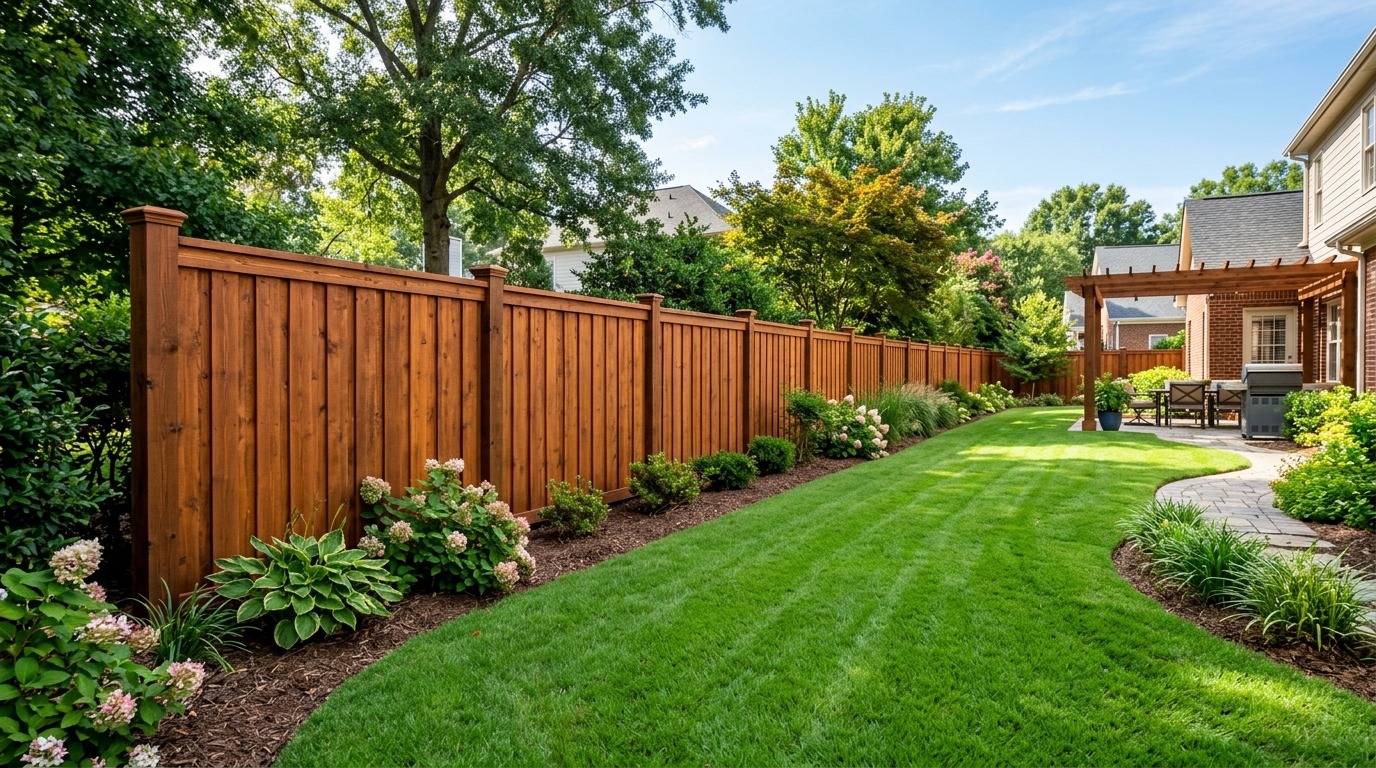
Why Cedar Takes Redwood Stain Exceptionally Well
Western Red Cedar has a porous, uniform grain structure with virtually no internal pitch or sticky resins. This allows deep penetration of oil-based finishes.
By treating seasoned Western Red Cedar with a premium semi-transparent oil stain tinted with trans-oxide redwood pigments, homeowners gain several key benefits:
- Authentic Redwood Tone: The stain imparts the rich, reddish-amber warmth of redwood while highlighting cedar’s natural grain.
- Maximum UV Defense: Trans-oxide pigments reflect ultraviolet rays, shielding the wood from the Carolina sun and preventing premature graying.
- Water Repellency: Deep-penetrating oils prevent rain absorption during severe summer thunderstorms.
- Major Cost Savings: You capture the appearance of all-heartwood redwood at a fraction of the cost.
Explore our custom styles in our Wood Privacy Fence Gallery.
Homeowner Decision Matrix: Cedar vs. Redwood in Charlotte
Use this checklist to choose the right material for your property:
Choose Western Red Cedar If:
- You want a proven 20- to 25-year fence with superior dimensional stability and all-heartwood integrity.
- You want lightweight gates that will not sag, bind, or stress your hinges.
- You prefer transparent contractor pricing backed by an established local supply chain.
- You plan to apply a redwood-tinted penetrating stain to combine redwood aesthetics with cedar efficiency.
Choose California Redwood If:
- Budget is no constraint, and you are prepared to special-order certified Clear All Heart or Construction Heart timber.
- You need to match an existing authentic redwood structure, such as a custom deck or arbor.
- You are willing to install commercial-grade steel reinforcement to support heavy gate leaves.
Build with Charlotte’s Timber Fencing Specialists
At Amour Fence, we believe lasting quality begins with hand-selected materials. We do not use prefabricated big-box panels or mystery-grade lumber. Every fence is hand-built on-site by skilled carpenters, fastened with corrosion-proof hardware, and built to withstand the humidity and storms of the Carolina Piedmont.
Whether you prefer the natural golden tones of Western Red Cedar or a custom redwood-toned finish, we deliver timeless curb appeal and boundary security.
Ready to Plan Your Custom Wood Fence?
- Call Our Craftsmen: (980) 300-1047
- Request a Property Visit: Get a Free Estimate
- Service Areas: Proudly serving Charlotte, Matthews, Pineville, Waxhaw, Weddington, Fort Mill, and surrounding communities.
Frequently Asked Questions
Is cedar or redwood better for fencing in North Carolina?
Western Red Cedar is generally the superior choice for residential fencing in North Carolina. While both species offer exceptional natural rot and insect resistance, California Redwood carries substantial transcontinental freight costs to the East Coast, and locally available lumber often contains high ratios of rot-prone sapwood unless expensive all-heartwood grades are custom ordered. Western Red Cedar is readily available in premium architectural heartwood grades through established regional supply channels.
Which is harder and more durable: cedar or redwood?
On the Janka hardness scale, California Redwood rates at approximately 450 lbf, making it about 28% harder and more dent-resistant than Western Red Cedar (350 lbf). However, in terms of outdoor biological durability and decay resistance, all-heartwood grades of both species perform almost identically, lasting 20 to 25+ years above ground when maintained properly.
Why does redwood fencing cost so much more in Charlotte, NC?
Redwood grows almost exclusively in the coastal fog belt of Northern California and Southern Oregon. Shipping heavy raw lumber across 2,500 miles to North Carolina adds steep freight surcharges and regional distribution markups. Western Red Cedar benefits from well-established East Coast distribution hubs, delivering comparable luxury performance without the Pacific freight penalty.
Why do black streaks appear around fence nails on cedar and redwood?
Both cedar and redwood contain high concentrations of natural tannic acid. When standard zinc-plated or electro-galvanized nails contact rainwater and humid air, the tannins trigger an electrochemical reaction that forms black iron-tannate stains. To prevent permanent black weeping, both species must be assembled exclusively with 304 or 316 stainless steel or double hot-dipped galvanized (ASTM A153) fasteners.
Can you make a cedar fence look like redwood?
Yes. Applying a premium semi-transparent penetrating oil stain formulated with redwood oxide pigments onto Western Red Cedar replicates the deep, rich cinnamon-brown aesthetic of redwood. The stain enhances cedar's natural grain, delivers crucial UV-inhibitor protection against Carolina sun graying, and saves homeowners thousands of dollars compared to importing raw redwood lumber.