
Quick Answer: What Is the Best Wood for a Privacy Fence?
The single best wood species for a residential privacy fence in the Carolinas is Western Red Cedar. Unlike pressure-treated pine, which is installed waterlogged and shrinks up to 3/8 inch per board under the summer sun, Western Red Cedar offers superior dimensional stability with nearly half the shrinkage rate. Cedar pickets remain flat, resist cupping, and preserve a 100% gap-free sightline year after year. When paired with a Board-on-Board construction layout, cedar provides permanent, maintenance-friendly privacy that withstands Charlotte’s intense humidity.
A residential privacy fence serves as the structural perimeter of your outdoor life. Whether enclosing an in-ground pool in Ballantyne, safeguarding pets in Matthews, or establishing an intimate patio retreat in Myers Park, the objective is straightforward: complete, uninterrupted visual seclusion.
Yet thousands of homeowners invest in a 6-foot privacy fence only to watch it fail its primary mission within 90 days. What began as a tightly fitted wall of wood turns into a screen riddled with vertical gaps, accompanied by warped, bowed pickets pulling free from their rails.
This failure rarely stems from bad workmanship. In most cases, the culprit is improper lumber selection that ignores the thermodynamics of wood shrinkage in the humid Carolina Piedmont.
In this engineering guide, the master builders at Amour Fence analyze 1x6 picket mechanics, board shrinkage physics, and why timber selection dictates privacy.
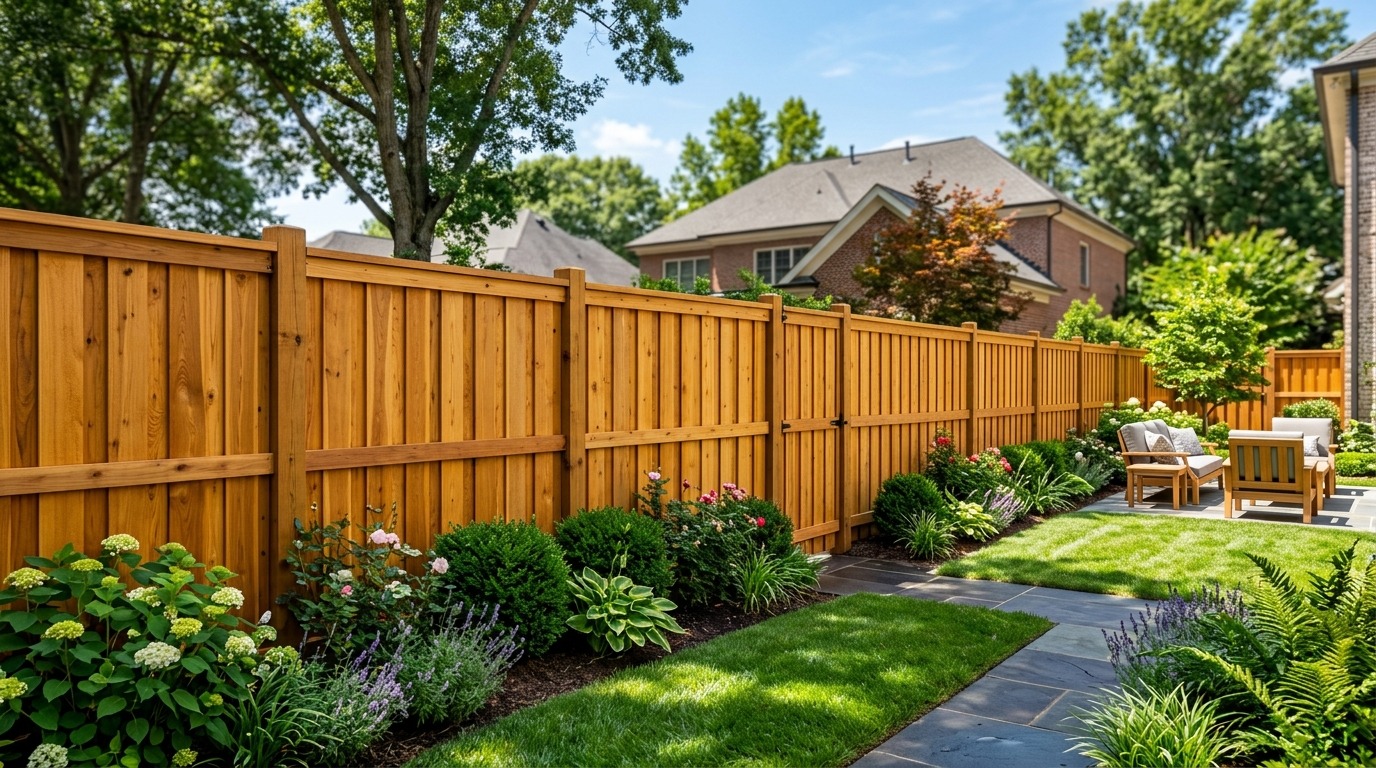
1x6 Lumber Stability & Shrinkage Comparison
In a 6-foot privacy fence, 1x6 pickets (measuring 5.5 inches net width) form the vast majority of the exterior surface area. Here is how common fencing woods compare under outdoor environmental stress:
| Technical Property | Western Red Cedar (Thuja plicata) | Pressure-Treated Pine (Pinus taeda) | Whitewood / Spruce (Picea spp.) |
|---|---|---|---|
| Radial Shrinkage Rate | 2.4% (Extremely Low) | 4.8% (Moderate) | 3.8% (Moderate) |
| Tangential Shrinkage Rate | 5.0% (Lowest of softwoods) | 7.4% to 8.0% (Very High) | 7.8% (High) |
| Typical Width Shrinkage on 1x6 | 1/16 in. to 1/8 in. | 1/4 in. to 3/8 in. | 1/4 in. to 5/16 in. |
| Moisture Content at Install | 12% to 15% (Air-dried / Kiln-dried) | 30% to 50%+ (Wet MCA treatment) | 19% to 25% (Green or kiln-dried) |
| Cupping & Warping Resistance | Superior (Uniform cellular rings) | Poor (Severe differential drying) | Very Poor (Violent twist) |
| Fastener Holding Retention | High (Low internal grain stress) | Poor (Shrinkage pulls nails out) | Very Poor (Fastener tear-out) |
| Natural Termite & Rot Defense | Natural Thujaplicins (Decades) | Chemical Copper Biocides (MCA) | None (Rots within 2 to 4 years) |
| Privacy Integrity After 1 Year | 100% Sightline Retained | Gaps appear; requires overlap | Gaps and curling edges expose yard |
For a broader evaluation across all lumber species, read our master Best Wood for a Fence Guide.
The Physics of Board Shrinkage: Why Gaps Open in Carolina Summers
Wood is a hygroscopic material. It continuously absorbs and releases moisture until reaching equilibrium with ambient humidity and temperature—its Equilibrium Moisture Content (EMC).
In Greater Charlotte, summer EMC typically settles around 12% to 14%. However, pressure-treated Southern Yellow Pine pickets arrive from treatment facilities saturated with waterborne chemicals under hydraulic pressure, often carrying moisture contents above 40%.
As wet pine boards bake under Charlotte’s 95°F summer heat, they shed gallons of moisture. Because wood contracts along annual growth rings (tangentially) twice as fast as it shrinks radially, a flat-sawn 1x6 pine board loses significant width:
- A 5.5-inch picket contracts down to roughly 5.15 to 5.25 inches.
- Fastened edge-to-edge with flush butt joints, this creates a 1/4-inch to 3/8-inch gap between every board.
- Along a 150-linear-foot fence line, those gaps total over 7 cumulative feet of exposed sightlines.
By contrast, Western Red Cedar is seasoned prior to milling, arriving on site near outdoor equilibrium (12% to 15% moisture). Cedar’s minimal 5.0% tangential shrinkage ensures that dimensional movement remains negligible, keeping picket seams tight.
Hydronic Tension & Cupping: The Sun vs. Shade Face Moisture War
Width shrinkage is only part of the problem. A more damaging issue is cupping—where a flat board curls into a concave trough.
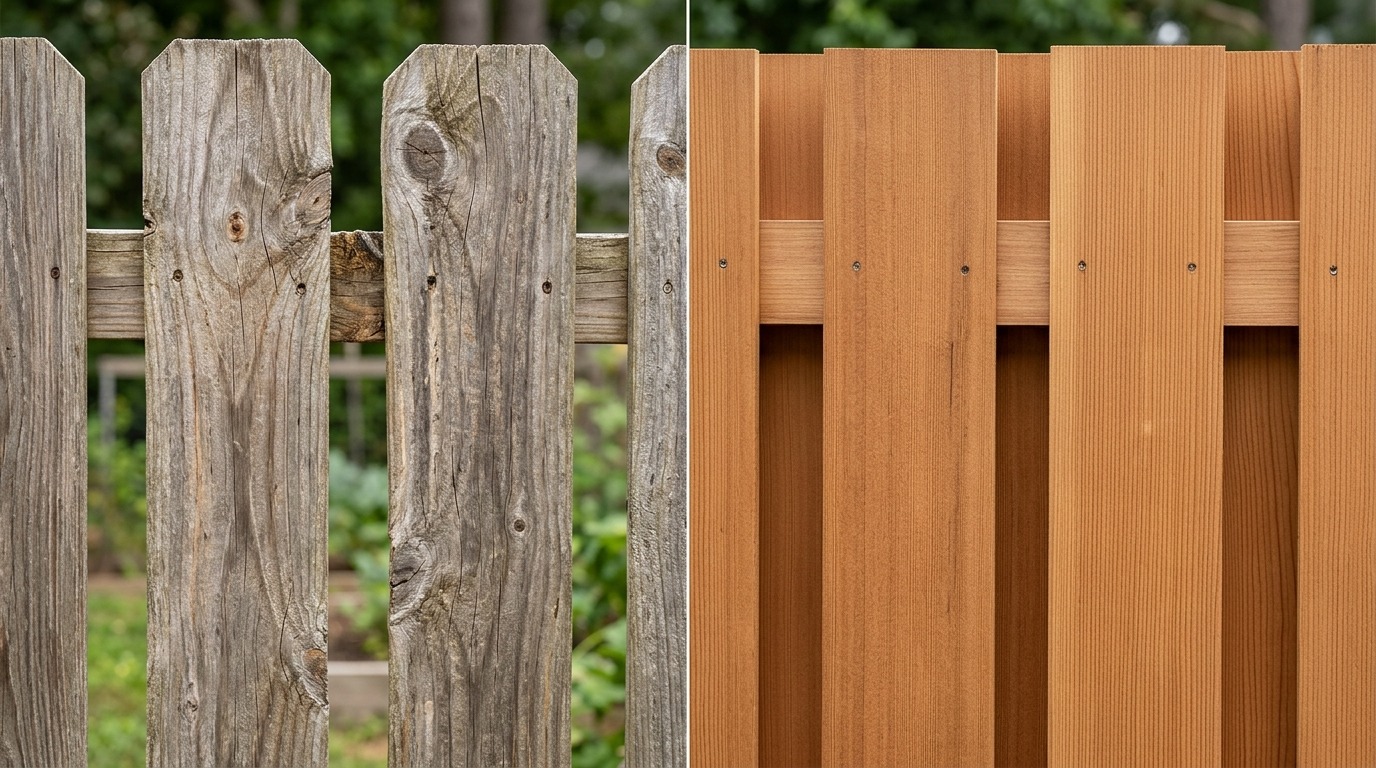
Why Privacy Pickets Curl
A solid privacy fence acts as a solar and moisture shield:
- The Outward (Sunny) Face: Heats up to 120°F+ in direct Carolina sunlight, rapidly losing water vapor.
- The Inward (Yard) Face: Stays shaded and damp from lawn evaporation, retaining moisture.
This creates severe differential drying tension. As the sunny exterior shrinks while the shaded back remains swollen, the board curls outward toward the sun.
In Southern Yellow Pine, alternating hard and soft growth rings amplify this warping force. Pickets curl with enough torque to shear nails or pull fastener heads straight through the wood grain (fastener tear-out).
Western Red Cedar features uniform cellular microfibrils with straight, close-grained fibers. Even under intense afternoon sun in Waxhaw or Fort Mill, cedar pickets maintain cross-sectional flatness.
Privacy Fence Styles: Engineering 100% Sightline Security
Choosing stable lumber is vital, but selecting the right architectural design guarantees lasting privacy.
PRIVACY FENCE PROFILES
─────────────────────────────────────────────────────────────────────────────
SOLID BUTT-JOINT:  [ Picket ] [ Picket ] [ Picket ]   ──► Gaps form as pine dries
BOARD-ON-BOARD:    [ Picket ]   [ Picket ]   [ Picket ]
                     [ Overlap Picket ] [ Overlap Picket ] ──► 100% Zero-Gap Privacy
─────────────────────────────────────────────────────────────────────────────
1. Solid Privacy (Flush Butt-Joints)
Pickets mount edge-to-edge in a single vertical plane against horizontal rails.
- With Cedar: Highly effective; low shrinkage preserves tight joints.
- With Pine: Not recommended; inevitable shrinkage gaps compromise privacy within months.
2. Board-on-Board (The Ultimate Privacy Design)
In a Board-on-Board Fence, base pickets are spaced 3.5 inches apart, and face pickets overlap the seams by 1 to 1.5 inches.
- Why It Works: When seasonal humidity shifts cause boards to expand or contract, the movement occurs beneath the overlap. Sightlines remain 100% blocked from any viewing angle.
- Aesthetic Value: Overlapping boards cast deep shadow lines that enhance architectural depth and curb appeal.
Explore custom layouts in our Wood Privacy Fence Gallery.
The Charlotte Climate Factor: Red Clay & Subterranean Longevity
Building a durable privacy fence in Charlotte requires addressing local ground conditions:
- Saturated Cecil Red Clay: Charlotte’s heavy clay traps water around post footings. While Western Red Cedar excels above ground, direct burial in damp clay can degrade cedar posts over 12 to 15 years.
- The Hybrid Solution: Amour Fence uses Ground-Contact Pressure-Treated Pine posts (AWPA UC4A) set 24 to 36 inches deep in gravel-drained concrete footings, paired with 100% virgin Western Red Cedar pickets and rails above ground. This matches underground rot defense with above-ground dimensional stability.
- HOA Guidelines: Subdivisions in Weddington, Pineville, and Matthews often require 6-foot maximum heights and “finished” outward-facing aesthetics. A Board-on-Board cedar design satisfies the strictest HOA bylaws.
Homeowner Decision Matrix
- Choose Western Red Cedar (Solid or Board-on-Board) for guaranteed tight seams, flat boards that never cup, and a 20- to 25-year lifespan with minimal upkeep.
- Choose Pressure-Treated Pine (Board-on-Board ONLY) if upfront budget is the primary driver. Never install pine with flush butt joints; specify a 1.5-inch overlap to conceal inevitable drying gaps.
- Avoid Untreated Whitewood or Spruce, which lacks rot resistance and warps violently within 3 years in Carolina humidity.
Build Your Custom Privacy Fence with Charlotte’s Timber Specialists
At Amour Fence, we engineer privacy fences to maintain total seclusion for decades. We never use prefabricated big-box panels. Our carpenters hand-select pickets on site, fasten boards with ring-shank stainless steel hardware, and anchor posts below the frost line in Charlotte clay.
Protect your family’s backyard privacy with craftsmanship built for the Carolinas.
Ready to Plan Your Privacy Fence?
- Call Our Craftsmen Directly: (980) 300-1047
- Request an On-Site Consultation: Get a Free Estimate
- Our Charlotte Service Area: Serving Charlotte, Matthews, Pineville, Waxhaw, Weddington, Fort Mill, and surrounding Mecklenburg and Union County communities.
Frequently Asked Questions
What is the best wood for a 6ft privacy fence in Charlotte, NC?
Western Red Cedar is the best wood for a 6-foot residential privacy fence in the Charlotte area. Cedar has a remarkably low tangential shrinkage rate (around 5%), meaning 1x6 pickets stay tight, flat, and true without opening wide gaps between boards. Its natural cellular thujaplicin oils also protect against rot, fungal decay, and subterranean termites without synthetic chemical treatments.
Why do pine privacy fence boards shrink and create gaps?
Pressure-treated pine lumber is typically sold and installed wet from the chemical treatment cylinder, often holding a moisture content above 30% to 50%. As the Carolina sun dries the lumber down to its equilibrium moisture content (12% to 15%), each 1x6 board shrinks tangentially across its width by up to 1/4 inch to 3/8 inch, turning a once-solid privacy fence into a screen with visible gaps.
How do you prevent privacy fence boards from warping and cupping?
Board cupping occurs when one side of a picket loses moisture faster than the other. On privacy fences, the outward sunny face bakes in 95-degree heat while the inward yard face remains shaded and damp, creating severe differential shrinkage tension. To prevent cupping, builders use dimensionally stable Western Red Cedar, fasten boards with two ring-shank stainless steel nails per rail, and construct fences using a Board-on-Board overlapping pattern.
Is Board-on-Board or Solid Privacy better for backyards?
Board-on-Board is the superior privacy style for long-term seclusion. By overlapping alternating 1x6 pickets by 1 to 1.5 inches, natural seasonal board shrinkage never reveals a direct sightline into your yard. Standard butt-joint solid privacy fences inevitably develop sightline gaps over their first summer as lumber contracts.
Does pressure-treated pine work for privacy fences if stained immediately?
No. Freshly installed pressure-treated pine contains high internal hydrostatic pressure and moisture that blocks stain absorption. Applying an oil or acrylic stain before pine dries to below 18% moisture content traps water inside, accelerating rot, blistering the finish, and doing nothing to prevent the board from shrinking as it cures.